
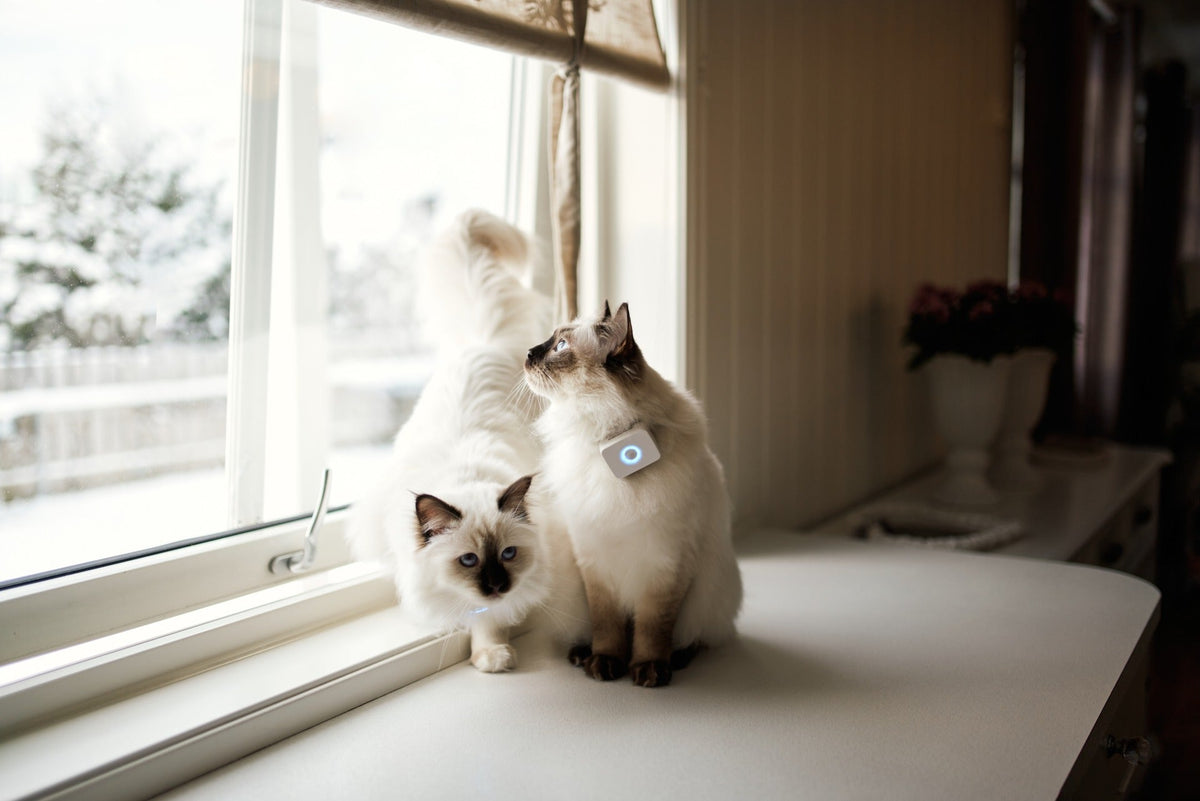
Looking for GPS for cats, or thinking about using a GPS tracker on your cat? A tracker can give you a better idea of where your cat goes. If they do not come home at the usual time, their last reported location can also give you a useful place to start looking.
For your cat, going outside may be part of an ordinary day. For you, much of it happens between two brief moments: your cat slipping out of the door, then appearing again later.
This guide explains how GPS tracking for cats works, what to look for in a cat GPS tracker, and how a GPS tracker differs from an AirTag. We also cover size, collars, coverage, battery life and subscriptions.

How does GPS tracking for cats work?
A GPS tracker for cats attaches to a suitable collar or another fitting recommended by the manufacturer. Signals from satellites help the tracker calculate its position. For you to see that location in an app, the data also needs to be sent on—usually through a mobile network.
GPS and mobile networks have different jobs: GPS helps the device work out where it is, while the mobile network can send that location to your phone. Some trackers can also use Bluetooth when the device is close to your phone.
A GPS tracker with a mobile connection can therefore send locations even when your cat is far away from you, as long as the tracker has battery power, can calculate a position and has a supported connection in the area. Read more about how GPS tracking for dogs and cats works in practice, or find out how NB-IoT and LTE-M transmit GPS locations.
What can you see with GPS on your cat?
The first thing many owners want to know is where their cat is right now. A GPS tracker can also give you more clues about the places your cat visits regularly.
Location history lets you see recorded points on a map. You might find that your cat stays closer to home than you expected, or that they keep returning to a particular corner of the neighbourhood or a nearby garden.
Location history shows recorded positions, not every step your cat takes. How detailed a route looks depends, among other things, on how often the device updates its location and whether it was able to get GPS and mobile coverage.
If your cat does not come home at the usual time, the last reported location can give you a place to begin your search. Always check the time of the update, too: a recent point and one from earlier in the day tell you different things.
What does real-time tracking mean?
Real-time tracking means the tracker can send new locations while it is in use. How often updates arrive depends on the model, settings and tracking mode.
When comparing GPS trackers for cats, look beyond whether a product uses the word “real-time”. Check how often the location is updated during normal use, whether you can choose more frequent updates when needed, and how that affects battery life.
A clear app should also show when the location was last recorded. That makes it easier to understand what the map is telling you.
Size and comfort: the tracker needs to suit your cat

Cats run, climb, squeeze through small gaps and curl up in compact spaces. Their equipment should fit in a way that lets them move naturally.
Consider the whole setup: tracker, fitting and collar. Look at the weight and shape, and check whether the device sits securely or swings around when your cat moves.
If you have a small cat or kitten, check the manufacturer’s guidance on size, age and any minimum weight. Not every GPS tracker is suitable for every cat.
Let your cat get used to the equipment at home before they wear it outdoors. Start with short periods under supervision, and check that the collar and fitting do not rub or get in the way when your cat walks, rests or grooms.
Choose a collar with a quick-release fitting
If your cat wears a collar, its fastening should release if the collar gets caught. Cats Protection recommends a quick-release collar. Its guidance also explains the risks of an ill-fitting collar.
Make sure the tracker fitting does not stop the quick-release mechanism from working. Check the fit regularly. A safety collar can come loose and be left behind, so a stationary point on the map could be a tracker attached to a lost collar.
Coverage and GPS accuracy where your cat goes
A GPS tracker is most useful when it works in the areas your cat visits. Check which mobile networks and technologies the model supports, and whether the service is available where you live.
GPS reception and mobile coverage are different things. A tracker may calculate a position but be unable to send it straight away. It may also have a mobile connection but struggle to get an accurate GPS position.
The surroundings can affect satellite signals. GPS.gov explains that buildings, bridges and trees can reduce GPS accuracy. Reception may be weaker or unavailable inside a shed, basement or garage.
Use the map as a guide alongside what you know about your cat. If they do not come home, the last reported position can help you narrow down where to look first. You could also ask neighbours to check garages and sheds where your cat might have been shut in.
Battery life: settings and use affect how often you need to charge
Battery life depends on how the tracker is used. Frequent location updates usually use more power than less frequent updates. Coverage, temperature and power-saving settings can also affect how long the battery lasts between charges.
Think about your cat’s routine. If they come home every evening, you can check the battery and charge the tracker when needed. If they spend longer periods outside, it is especially useful to understand battery use with your chosen settings.
With Lilcat, you can adjust Power Saving Mode and the update frequency in the app. Longer intervals can reduce power use, but they also mean fewer location updates. Choose settings based on how closely you need to follow your cat’s location.
Find practical help on the Lildog device help page, or read more about the Lildog app. You can also learn more about what affects battery life in pet GPS trackers.
GPS trackers for cats without a subscription: what should you compare?
If you are looking for a GPS tracker for cats without a subscription, start by checking how the device sends its location to your phone. Different tracking devices can show a point on a map, even though the technology behind them works in different ways.
GPS trackers that send data over a mobile network often require a subscription or have another ongoing cost for the connection and service. Other solutions may use Bluetooth, a network of nearby phones or a separate receiver. Some may also need a separate SIM card or mobile data.
Check whether the solution can send locations when your cat is far away, or whether it depends on other phones being nearby. Look at its range and whether you need extra equipment, too.
To compare costs, work out the total price of the device and service over the same period, such as one or two years. Include any contract term, payment period and cancellation conditions. You can find information about Lilcat subscriptions here.
AirTag on a cat: it does not have GPS
An AirTag does not have GPS. It is a Bluetooth-based item finder, not a GPS tracker with its own positioning and mobile connection.
Apple explains that an AirTag sends Bluetooth signals which nearby devices in the Find My network can detect. Those devices can then report the AirTag’s location. This means updates depend on a compatible device coming within range.
That can be an important limitation for a cat. If your cat goes somewhere with few people and few Apple devices nearby, you may not get a new location when you need one. An AirTag also does not provide independent GPS tracking or an ongoing route history in the same way as a GPS tracker with a mobile connection.
An AirTag may be useful for finding belongings, but it does not provide the same type of location updates as a GPS tracker for cats. Read our comparison of GPS and AirTag for dogs and cats.
If your cat wears a collar, the fitting must also suit them and must not interfere with the quick-release fastening. Whatever tracking option you choose, comfort and safety should come first.
Lilcat: GPS and activity tracking for cats
Lilcat is the GPS tracker for cats that we develop and sell. It combines location tracking, location history and activity monitoring in an app for iOS and Android.
Lilcat 2 weighs 28 grams and measures 47 × 36 × 15 millimetres. It has light and sound functions and is rated IP67. You can find specifications and subscription information on the Lilcat 2 product page.
Location history gives you an insight into recorded trips, while activity monitoring shows more about your cat’s movement over time. It can also be interesting if you simply want to learn more about your cat’s life outside the home.
As with any GPS tracker, consider the fit, coverage and charging routine for your cat. You can read more about Lildog and the technology behind GPS tracking for dogs and cats.
Can a microchip track a cat?
A standard ID microchip under the skin does not show your cat’s location on a map. It contains an identification number that can be read with a scanner and matched to the owner’s contact details.
GPS and a microchip therefore have different purposes. A tracker can provide location information and help you identify an area to search. A microchip can help the person who finds your cat identify them and contact you—even if the collar has come off.
Cats Protection explains how cat microchipping works. Keep the contact details linked to the chip up to date.
What to check before choosing a GPS tracker for your cat
The best option is one that suits your cat, works in the areas they visit and is easy to use day to day. Before choosing a GPS tracker for your cat, check:
- Fit: Are the size, weight and fitting suitable for your cat?
- Safety: Can the tracker be attached without preventing the collar’s quick-release fastening from working?
- Coverage: Does the service work in the areas your cat usually visits?
- Updates: How often is the location recorded, and does the app clearly show the time of the last update?
- Battery: How often will you need to charge it with your preferred settings?
- App: Are the map, location history and battery status easy to understand?
- Cost: What is the total cost of the tracker, accessories and subscription?
- Technology: Does the device have GPS and its own connection, or does it rely on Bluetooth and phones nearby?
A GPS tracker can give you more clues about your cat’s outings and help you decide where to start looking if they go missing. It does not replace identification or supervision, but it can offer a new insight into the life your cat leads beyond your view.
Frequently asked questions about GPS for cats
How far away can a GPS tracker for cats work?
A GPS tracker with a mobile connection does not have the same distance limit from your phone as a basic Bluetooth tag. It can send locations over long distances when it has battery power, can calculate its position and has mobile coverage in an area supported by the service.
Does GPS for cats work indoors?
Satellite signals can be weak or unavailable indoors. Some trackers can use other technologies as a supplement. Always check the time of the last reported location and find out which connections the model supports.
Can a kitten wear a GPS tracker?
It depends on the kitten and the model. Follow the manufacturer’s guidance on size, age and any minimum weight. Consider the tracker, fitting and collar together, and let the kitten get used to the equipment under supervision.
Does a GPS tracker for cats need a subscription?
Many GPS trackers that send locations over a mobile network require a subscription or another ongoing payment. Other solutions may have different costs and limitations. Check how they transmit the location, what range they offer and whether extra equipment is needed.
Does an AirTag have GPS?
No. An AirTag does not have GPS. It sends Bluetooth signals that nearby devices in Apple’s Find My network can detect and report. If there are few of these devices near your cat, its location may become out of date.
Can GPS replace a cat’s microchip?
No. A GPS tracker can show location information, while a microchip helps identify your cat if someone finds them. Your cat should still be microchipped even if they wear a GPS tracker.
Which GPS tracker for cats is best?
There is no single model that suits every cat and home. Look for a comfortable fit, coverage in your cat’s local area, clear location updates and battery and cost arrangements that work for your routine.
Share:
Golden, Labrador or Toller – Which Retriever Is Right for You?
Can You Track a Cat with a Microchip? How Cat Microchips Work