
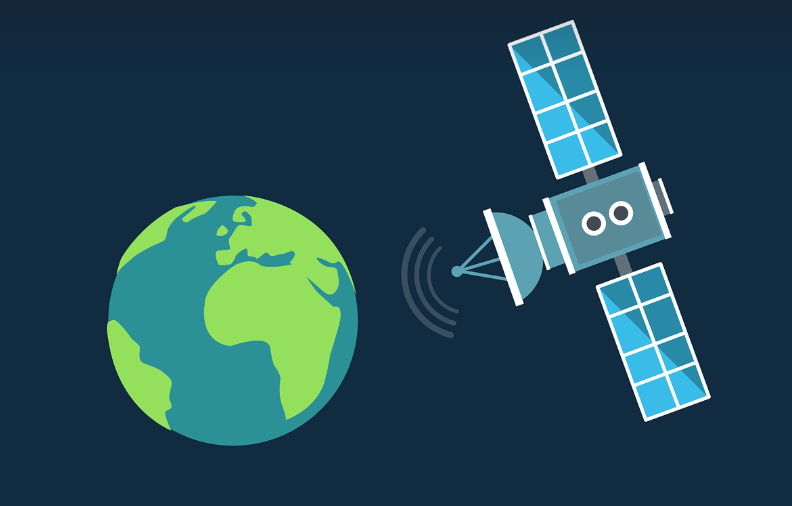
A GPS tracker for a dog or cat looks simple from the outside: you attach it to the collar and open a map on your phone. Behind the small dot in the app, however, several different technologies are working together.
Satellites help the tracker calculate its position, the mobile network sends the information onwards, Bluetooth helps when the pet is nearby, and the software turns technical data into something useful. How quickly and accurately this works depends on factors such as the terrain, satellite visibility, mobile coverage, tracking mode and battery level.
This guide explains the entire journey, from the moment the tracker receives a signal to the point where your dog or cat appears on the map.
How GPS tracking works step by step
A GPS tracker is essentially a small communication system. It has to determine where it is, transmit that information and present it in a form that is easy to understand.
The tracker receives signals and calculates its position.
The position is sent from the tracker through the mobile network.
The data is processed and made available in your account.
You see the latest recorded position and time in the app.
If one part of this chain is unavailable, a new position cannot be displayed immediately. The tracker may, for example, have good contact with the satellites but lack the mobile coverage needed to send its position.
1. Satellites tell the tracker where it is
GPS stands for Global Positioning System. Today, GPS is often used as a general term for satellite-based positioning, although receivers may also use other global satellite systems. The collective term for these systems is GNSS: Global Navigation Satellite System.
Satellites transmit radio signals containing extremely precise information about time and orbit. The tracker compares signals from several satellites and calculates where it is. The satellite does not follow the dog, nor does it send the dog’s position directly to your phone.
An important distinction: the satellite system helps the tracker calculate its position. The mobile network is then used to send that position from the tracker to the app.
Where does satellite positioning work best?
The tracker will usually have the best view of the satellites outdoors, particularly in open areas. Conditions become more difficult when signals are blocked or reflected by the surroundings.
- Open countryside: normally provides good conditions and stable positioning.
- Dense woodland: foliage and terrain can weaken or delay the signals.
- Between tall buildings: signals may be reflected, causing the position to jump on the map.
- Inside buildings: roofs, walls and concrete can significantly weaken satellite signals.
- In valleys and steep terrain: mountains and slopes may block parts of the sky.
If the position takes longer to update indoors or between tall buildings, it does not necessarily mean that the tracker is faulty. The surroundings have a major effect on satellite reception.
2. The mobile network sends the position onwards
Once the tracker has calculated its position, the information has to reach you. A long-range GPS tracker therefore uses mobile communication, much like a phone, but often through network technology designed for small, energy-efficient devices.
Technologies such as LTE-M and NB-IoT were developed for the Internet of Things, commonly shortened to IoT. They are designed for devices that transmit relatively small amounts of data while using as little power as possible.
Because the tracker has a mobile connection, the distance between you and your pet is not the main limitation. Your dog could be on the other side of the city while you check its position from home. The tracker must, however, be in an area with a compatible mobile network.
Does a GPS tracker have a SIM card?
A mobile-connected tracker needs a way to identify itself on the network. This may be a physical SIM card or an integrated SIM solution. Owners do not normally need to insert or manage an ordinary mobile subscription themselves; the connection is handled through the tracker’s service and subscription.
3. Bluetooth helps when your pet is nearby
Bluetooth has a shorter range than the mobile network, but it uses relatively little power. A GPS tracker can therefore use Bluetooth to communicate with your phone when the dog or cat is nearby.
Bluetooth may be used for:
- setting up and pairing the tracker
- communication between the phone and tracker over a short distance
- reducing the need for more energy-intensive mobile communication
- detecting that the owner and tracker are close to one another
Bluetooth is therefore a useful supporting technology, but it is not the same as satellite-based GPS tracking.
GPS tracker or Bluetooth tag: what is the difference?
This is one of the most common sources of confusion when people look for a tracker for a dog or cat. A small Bluetooth tag may appear on a map, but that does not necessarily mean the tag has GPS or its own mobile connection.
| Feature | GPS tracker with mobile connectivity | Bluetooth tag |
|---|---|---|
| Determines its own position | Yes, using satellite signals | Usually not |
| Sends its own position | Yes, when compatible mobile coverage is available | No, it relies on nearby phones |
| Range | Not limited by the distance to the owner’s phone | Depends on Bluetooth and a network of other devices |
| Suitable if a dog runs a long distance | Yes, provided satellite reception and mobile coverage are available | Less predictable, especially in areas with few people |
| Ongoing subscription | Usually | Usually not |
| Battery life | Often several days, depending on use | May last for many months or longer |
A Bluetooth tag can be useful for keys, luggage or belongings that are often close to people carrying compatible phones. For a dog in the woods or a cat in a quiet area, an independent GPS tracker with a mobile connection is normally the more appropriate option.
If you are considering an Apple AirTag as a cheaper alternative, read our detailed comparison of a GPS tracker and an AirTag for dogs and cats. It looks at range, updates, mobile coverage, battery life and the situations each type of tracker is suited to.
4. The app turns technology into useful information
Raw satellite coordinates are not especially useful to most dog owners. The app turns technical data into a map, a time and an overview that are easy to understand.
Depending on the product and subscription, an app may display:
- the latest recorded position
- the time at which the position was recorded
- location history and previous movements
- walks, distance and duration
- activity and step count
- battery level and connection status
- temperature data from the sensor in the device
- controls for built-in light and sound
Always check the time: the dot on the map does not necessarily show where your pet is at this exact second. Check when the position was last updated before deciding which direction to search.
Live tracking and regular position updates
A battery-powered tracker cannot run its GPS receiver and mobile communication at maximum intensity all the time. Doing so would reduce battery life considerably. Most trackers therefore use different update intervals or tracking modes.
Normal mode
During everyday use, the tracker balances visibility with battery life. The position is updated at intervals influenced by the product’s settings, movement and connection. This mode is suitable for normal use throughout the day.
Live or panic mode
When a dog has escaped, you need more frequent position updates. An intensive tracking mode makes the device work more actively with both positioning and communication.
This can provide a much clearer picture of the direction in which the dog is moving, but it also uses more power. Intensive tracking should therefore be activated when it is genuinely needed.
A GPS tracker does not replace a lead or reliable recall. It is an additional safety tool in case the dog gets loose. During the general leash period in Norway, the dog must still be physically secured in accordance with the applicable rules.
How accurate is a GPS tracker for dogs?
There is no single fixed figure that describes GPS accuracy in every situation. Under good conditions, the displayed position may be very close to the pet’s actual location. In challenging surroundings, the margin of error may be larger.
Accuracy is particularly affected by:
- how much of the sky the tracker can see
- the number of satellite signals it can use
- tall buildings, mountains, trees and other obstructions
- signals reflected by walls and hard surfaces
- how quickly the animal is moving
- how recently the device calculated and transmitted a new position
A line in the location history is not a millimetre-accurate record of every step the dog took. The app connects recorded position points. If there is time between those points, the line may cut across a building, woodland or other terrain even when the dog followed a road.
What happens when the dog moves outside mobile coverage?
GPS and mobile coverage are two different things. In some situations, the tracker may be able to calculate where it is without being able to send that information to the app immediately.
When the mobile connection disappears, the app will normally show the last position it successfully received. This is why the time displayed beside the position is so important.
Once the connection returns, the tracker can begin sending new updates again. How data from the period without coverage is handled varies between manufacturers and products.
When searching for a missing pet, use:
- the last known position and time
- the direction in which the pet was moving
- its previous movement patterns
- roads, water, terrain and other natural obstacles
- sightings reported by people in the area
Try to remain calm if your dog gets loose. Use the latest position together with its time and direction of movement instead of relying only on the dot on the map.
What affects battery life?
Battery life always involves a trade-off. More frequent positions and more communication provide a better overview, but they also require more energy.
| Condition | Typical effect on the battery | Why? |
|---|---|---|
| Frequent live tracking | Higher power consumption | GPS and mobile communication operate more often. |
| Poor mobile coverage | May increase power consumption | The device may use more energy trying to establish a connection. |
| Poor satellite visibility | May increase power consumption | Calculating the position may take longer. |
| Cold weather | May reduce available capacity | Batteries generally perform less efficiently at low temperatures. |
| Frequent movement | May increase power consumption | The tracker may wake up and record information more frequently. |
| Nearby Bluetooth connection | May reduce power consumption | Short-range communication normally requires less energy. |
How to make battery life more predictable
- Charge the tracker before long walks and journeys.
- Check the battery level before allowing the dog off lead in a safe area where this is permitted.
- Use intensive tracking when the situation requires it, rather than leaving it on permanently.
- Keep both the app and the device software up to date.
- Make sure the necessary Bluetooth and location permissions are enabled.
- Do not wait until the battery is almost empty before visiting an area with unstable coverage.
- Set a longer interval between location updates in the app settings.
- Enable power-saving mode in the app so the tracker can enter sleep mode after remaining still for an extended period.
Why does a GPS tracker need a subscription?
A long-range GPS tracker uses more than free satellite signals. It also needs to communicate through mobile networks and a digital service that manages the data, user account, maps and app features.
The subscription will normally help cover:
- mobile connectivity and data traffic
- servers that receive and process location data
- map and app functions
- storage of location history
- development, security and operation of the service
A tracker without an ongoing fee is therefore not necessarily an equivalent alternative. It may rely on Bluetooth and nearby phones rather than having its own connection for long-distance tracking.
How does a tracker measure activity?
Many GPS trackers also contain motion sensors. These sensors register changes in movement and direction, and the software uses the information to estimate activity, rest or step count.
Activity data is not the same as a veterinary examination. Its main value lies in following changes and routines over time. If your dog suddenly moves less than usual, sleeps differently or changes its routine, that may be a reason to pay closer attention.
A single day’s measurement often tells you less than the pattern across several days or weeks. It is therefore best to compare your pet with its own normal activity rather than only comparing it with other dogs or cats.
What does the temperature sensor tell you?
A temperature sensor in the tracker measures the temperature in or around the device itself. It does not measure your dog’s body temperature in the same way as a medical thermometer.
The reading may still be useful for identifying changes or unusual conditions in the surroundings. Direct sunlight, body heat, fur, activity and the position of the device on the collar can all affect the result.
Do not use the tracker’s temperature reading as a medical diagnosis. If your dog shows signs of overheating, hypothermia or illness, assess the animal’s symptoms and contact a vet when necessary.
What should you look for when choosing GPS for a dog or cat?
It is easy to compare only price and advertised battery life. In practice, you should consider the complete solution:
- Independent GPS and mobile connectivity: can the device determine and send its position without nearby phones?
- Coverage: which networks and countries are supported?
- Tracking mode: are more frequent updates available when the pet goes missing?
- Position time: can you clearly see how old the latest location is?
- Size and weight: is the tracker comfortable for the animal?
- Water resistance: can it handle rain, mud and everyday use?
- Battery and charging: does the charging routine suit the way you intend to use it?
- Attachment: does the device remain securely attached to the collar or harness?
- App and customer support: is the system easy to use when the situation becomes stressful?
- Subscription: what is included, and how long is the commitment?
How to use a GPS tracker more safely
- Charge and test it at home. Do not wait until a holiday or long hike to learn how the app works.
- Check the attachment. A tracker is of little use if it falls off the collar.
- Check the permissions. Bluetooth, notifications and location access must be configured correctly.
- Read the time. Distinguish between the last received position and a completely new update.
- Test intensive tracking. Make sure you know how to activate it before your dog goes missing.
- Use it preventively. The tracker must already be attached to the animal before something happens.
GPS is particularly useful in unfamiliar surroundings, on holiday, at a holiday cottage and in areas where large distances can make searching difficult. If you are planning a trip, read our guide to visiting Norway with your dog.
GPS, activity and safety in one solution
Lildog combines satellite positioning, Bluetooth and mobile IoT with location history, activity tracking, light and sound functions. The tracker is developed for dogs and tested in Nordic conditions.
View the Lildog GPS tracker for dogsFrequently asked questions about GPS for dogs and cats
Does a GPS tracker work without a phone nearby?
Yes. A GPS tracker with its own mobile connection can send its position without being close to the owner’s phone. The tracker needs access to a compatible mobile network, while your phone needs an internet connection to retrieve the latest information in the app.
What is the range of a GPS tracker?
A mobile-connected GPS tracker does not have a fixed maximum range measured from your phone. It can work far away from you as long as the tracker has sufficient satellite reception and mobile coverage. A Bluetooth-only tag, on the other hand, relies on nearby phones or other compatible devices.
Does GPS for dogs work in woodland?
Yes, but dense woodland, valleys and steep terrain can reduce both satellite reception and mobile coverage. Updates may therefore be slower or less accurate than they would be in open countryside.
Does the GPS tracker work indoors?
Satellite signals often become weaker indoors. The app may therefore display the last known position, use other available signals or need more time to obtain a new satellite position.
Can I track my dog if my phone has no signal?
Your phone needs an internet connection to retrieve new data from the service. If it has no mobile signal, it may be able to use Wi-Fi. At the same time, the tracker needs its own compatible network connection to send new positions.
Why does the position jump on the map?
Satellite signals can be blocked or reflected by buildings, mountains, trees and other obstacles. This may cause temporary deviations. Check the time of the position and look at several points before interpreting the direction of movement.
How often is the position updated?
This depends on the tracker, selected mode, movement, network and software. Normal use will often have longer intervals to conserve battery, while intensive tracking provides more frequent updates.
Why does live tracking use more battery?
The tracker has to calculate and transmit its position much more frequently. Its satellite receiver, processor and mobile communication are therefore more active than during normal power-saving use.
Can a GPS tracker replace a microchip?
No. A microchip provides permanent identification when a found animal is scanned. A GPS tracker is used to follow the animal’s position. The two solutions have different purposes and complement one another.
Can a GPS tracker prevent my dog from running away?
No. The tracker cannot physically prevent a dog from escaping. It can, however, make it easier to view the latest position and follow the dog’s movement if it gets loose.
Does GPS for dogs require a subscription?
A tracker that transmits data through the mobile network will normally require a subscription. This helps cover mobile communication, servers, maps, location history and app features.
Does the same technology work for cats?
Yes. The basic principle involving satellite positioning, mobile networks and an app is the same. Low weight, secure attachment, size and comfort are particularly important when choosing a tracker for a cat.
Summary: from satellite to a dot on the map
GPS tracking for dogs and cats depends on several technologies working together. Satellites help the tracker determine its position. The mobile network sends the information onwards. Bluetooth handles short-range communication, while the app makes the data easy to understand.
This also explains the limitations. Without good satellite visibility, the position may be less accurate. Without mobile coverage, a new position cannot be sent to the app immediately. More frequent tracking provides a better overview, but it also uses more battery.
Understanding this chain makes it easier to interpret the map correctly, choose an appropriate tracker and use it in a way that provides genuine reassurance in everyday life.
Share:
30 Dog Facts That May Surprise You
What Is Lildog? Norwegian-Made GPS Tracking for Dogs and Cats