
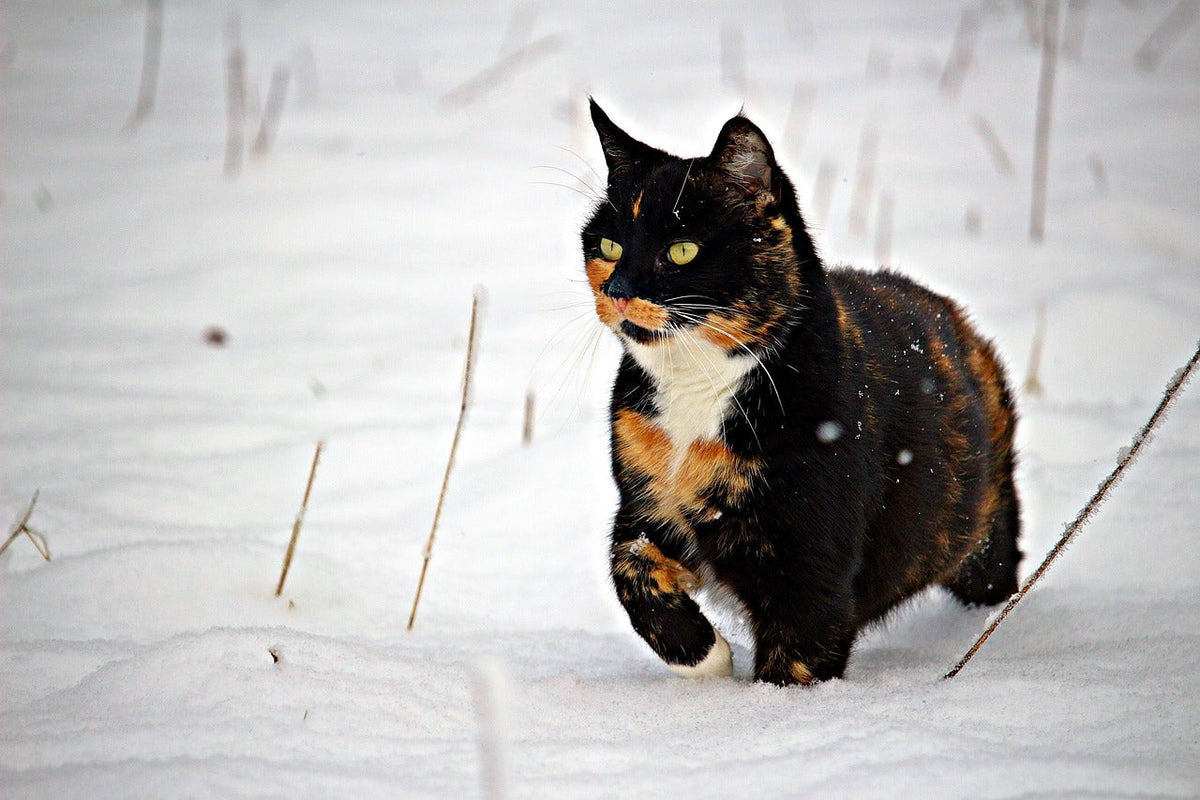
Calico Cats: Colors, Genetics and Why Almost All Are Female
A Calico cat—sometimes called a tricolor or three-colored cat—is not a breed. Calico describes a coat pattern with white, black and orange areas, or the diluted equivalents of blue-gray and cream. The pattern can occur in mixed-breed cats and in several recognized breeds.
Quick answer
Almost all Calico cats are female because the genetic variant associated with orange fur is located on the X chromosome. Females usually have two X chromosomes and can inherit the orange variant on one and a non-orange version on the other. Random X-chromosome inactivation in developing cells creates a mosaic of orange and dark patches. White spotting is produced by a separate genetic mechanism.

What is a Calico cat?
A Calico cat has three visible groups of color in its coat. The classic combination is white, black and orange. The terms Calico, tricolor cat and three-colored cat all describe this distinctive appearance.
Calico refers to color and the distribution of the patches—not the cat’s breed, size or coat length. Calicos may have short or long hair and may be pedigree or mixed breed. Their markings also vary: one cat may have large, clearly separated blocks of color, while another has many smaller patches.
The pattern is closely connected with sex chromosomes, but coat color alone is not a genetic test. The overwhelming majority of Calicos are female. Genuine male Calico cats do exist, but they are exceptional.
Calico cat facts
| Other names | Tricolor cat, three-colored cat |
|---|---|
| Is Calico a breed? | No. It is a coat-color pattern. |
| Classic colors | White, black and orange |
| Dilute colors | White, blue-gray and cream |
| Most common sex | Female |
| Male Calicos | Very rare; several chromosomal or cellular explanations are possible |
| Personality | Coat color cannot reliably predict an individual cat’s temperament |
What colors can a Calico cat have?
The classic Calico coat combines white with black and orange areas. White often separates the other colors, making the patches look more clearly defined.
A dilute Calico has softer colors: black is visually diluted to blue-gray, while orange appears cream. Some Calicos also show tabby stripes within their colored patches. This combination may be called a tabby Calico or caliby.
- Classic Calico: white, black and orange.
- Dilute Calico: white, blue-gray and cream.
- Tabby Calico or caliby: a tricolor pattern with visible tabby markings in some areas.

Why are almost all Calico cats female?
The explanation begins with sex chromosomes. In general, female cats have two X chromosomes (XX), while males have one X and one Y chromosome (XY). The genetic variant responsible for orange fur is X-linked.
A female can inherit the orange variant on one X chromosome and a non-orange version on the other. Early in embryonic development, each cell randomly switches off one of its two X chromosomes. This process is called X-chromosome inactivation.
In some areas of skin, the X chromosome associated with orange remains active; in other areas, the X that permits dark pigment stays active. As these cells multiply, they form groups that produce the familiar orange and black patches.
White areas arise through a separate mechanism affecting the distribution of pigment-producing cells. Together, these processes create the classic white, black and orange Calico pattern.

The 2025 discovery behind orange cat fur
A century-old genetic mystery was finally solved
In 2025, independent teams at Kyushu University and Stanford identified a small DNA deletion associated with ARHGAP36 on the X chromosome. The variant turns this gene on in melanocytes—the cells that produce pigment—and changes the pathway that determines whether fur becomes dark or orange.
The discovery provided the molecular explanation for a pattern geneticists had understood more broadly for decades. In a female with the orange variant on one X chromosome and the non-orange version on the other, random X inactivation creates groups of orange and dark cells. This produces tortoiseshell or Calico coats, depending in part on the cat’s white spotting.
The two studies were published independently in Current Biology in May 2025. They replaced the older, nonspecific idea of an unidentified “orange gene” with a much more precise account of the variant and its effect on pigment cells.
Can a male Calico cat exist?
Yes, but male Calicos are very rare. A typical XY male has only one X chromosome, so he will normally express the orange or non-orange version—not a mosaic of both.
One common explanation for a male Calico is an XXY chromosome arrangement. With two X chromosomes, the cat can carry an orange version on one and a non-orange version on the other; X inactivation can then create colored patches. Many XXY male cats are infertile.
XXY is not the only possible explanation. Scientific reports also describe mosaicism and chimerism, in which different cells within the same animal do not all have exactly the same genetic composition.
A coat pattern cannot reveal a cat’s chromosomes, fertility or overall health. If you have an apparently male Calico and want to understand the cause, a veterinarian can perform an examination and advise whether genetic testing is appropriate.
Calico vs tortoiseshell: what is the difference?
Calico and tortoiseshell describe coat patterns, not breeds. Both can combine orange and dark pigment, but they are usually distinguished by the amount of white and the way the colors are distributed.
| Feature | Calico | Tortoiseshell |
|---|---|---|
| Main colors | White, black and orange | Black and orange, or their dilute equivalents |
| Amount of white | Usually clearly visible | Usually little or none |
| Color distribution | More distinct patches or blocks | More blended, mottled or marbled |
| Most common sex | Female | Female |
Terminology can vary between countries and cat registries. A cat with large white areas and separated black and orange patches is generally described as Calico.
What does a Calico kitten look like, and which breeds can be Calico?
A Calico kitten’s patches are usually visible from birth. Contrast and coat texture may change as the kitten grows—particularly in long-haired cats—but the basic pattern does not suddenly develop for the first time in adulthood.
Because Calico is not a breed, the pattern can appear in mixed-breed domestic cats and in many recognized breeds that permit this color, including:
- Domestic Shorthair and Domestic Longhair
- American Shorthair
- Maine Coon
- Norwegian Forest Cat
- Persian
- Japanese Bobtail
Color standards differ between breeds and registries. A Calico coat alone cannot prove that a cat belongs to any particular breed.

Do Calico cats have a special personality?
Some owners refer affectionately to “Calico attitude” or “cattitude,” describing their cats as determined, independent or especially expressive. These stories are enjoyable, but coat color cannot reliably predict an individual cat’s temperament.
Owner-survey studies have reported associations between some coat colors and certain behaviors. An association does not show that color causes the behavior, however, and survey responses may be influenced by human expectations.
Personality depends on many factors, including genetics, early socialization, health, past experiences, environment and relationships with people. A Calico may be outgoing and affectionate, reserved, energetic or relaxed—just like a cat with any other coat.
Coat color also does not determine whether a cat produces more or less allergen. If allergies are relevant to your household, read our evidence-based guide to hypoallergenic cats and cat allergies.
Calico cats, good luck and popular culture
Calico cats have become symbols of good fortune in several cultures. In Japan, the familiar maneki-neko—the figurine of a cat raising one paw—is often depicted with a tricolor coat.
The Calico’s striking appearance and the rarity of males have inspired stories about prosperity and protection. These beliefs belong to folklore; they do not describe biological qualities or guarantee that a cat will have a particular personality.
Keeping an outdoor Calico cat safer
Distinctive markings can help someone recognize a cat, but they cannot show you where the cat is if it roams away from home. For cats with outdoor access, a registered microchip, current contact details and an appropriate routine remain essential safety measures.
Our guide to how far cats roam from home explains why distance and territory vary so much between individuals.
Want to understand your cat’s routes?
The Lilcat 2 GPS Tracker for Cats lets you check your cat’s location and review movement history. A GPS tracker complements—but does not replace—a microchip and responsible management of outdoor access.
You can also use our cat age calculator to estimate your cat’s life stage, or read our Chonk Chart and feline body-condition guide to learn why body condition matters more than a cat’s outline in a photograph.
Frequently asked questions about Calico cats
Is a Calico cat a breed?
No. Calico describes a coat pattern that can occur in mixed-breed cats and in several recognized breeds.
Are all Calico cats female?
No, but the overwhelming majority are female. Male Calicos are exceptional and may have variations such as XXY chromosomes, mosaicism or chimerism.
Are male Calico cats fertile?
Many male Calicos with XXY chromosomes are infertile, but coat color alone cannot determine fertility. A veterinarian must assess the individual cat.
What is the difference between Calico and tortoiseshell?
Calicos usually have clearly visible white areas and more separated black and orange patches. Tortoiseshell cats generally have little or no white, and their orange and dark colors look more blended or mottled.
Can a Calico cat be gray?
Yes. A dilute Calico combines white with blue-gray and cream instead of strong black and orange.
How much does a Calico cat cost?
There is no standard price for being Calico. Cost depends on whether the cat is adopted or obtained from a responsible breeder, as well as breed, health testing, country and other factors. Color should never be valued above health and welfare.
Summary
A Calico is not a breed but a white, black and orange coat pattern. Almost all Calicos are female because orange coloration is X-linked, and random inactivation of one of the two X chromosomes creates a mosaic of orange and dark cells.
Male Calicos exist, but they are very rare and can have several genetic explanations. Coat color does not determine a cat’s breed, value or personality. Its health, environment and care matter far more than its markings.
Scientific sources
- Kyushu University: discovery of the ARHGAP36 variant associated with orange fur
- Current Biology: ARHGAP36, tortoiseshell and Calico coat coloration
- Stanford Medicine: independent research into the genetics of orange cats
- PubMed: review of male tortoiseshell and Calico cats involving aneuploidy, mosaicism and chimerism
- University of California: owner-survey study of coat color and behavior
Share:
Hypoallergenic Dogs: 15 Dog Breeds Often Better Suited for Allergy Sufferers
New Puppy at Home? How a GPS Dog Tracker Brings You Peace of Mind