
Product and future – Lildog on the way forward
We receive many questions from shareholders about the product, the technical solution and what makes Lildog different from others. We also receive many suggestions for new features and wishes for the future. We appreciate that. It shows that the commitment is increasing, and that more and more people see the potential in our technology.
In this update, we want to give you an insight into what we have today, what we have learned, and what is coming.
Lildog 2 – basic features
Since the launch of Lildog 2, we have developed a neural network on the device itself that analyzes the dog's movements. This forms the basis for future health data and the avatar that will mirror the dog in real time - two features that will clearly differentiate Lildog from everything else on the market.
At the same time, the software in Lildog 2 contains an algorithm that continuously sends data back to us, allowing us to analyze how the device actually behaves in real environments. This has given us valuable insight into the interaction between location, surroundings, movement, temperature and signal strength – and how the device actually “thinks” in different situations.
After thousands of hours of data from actual users, we have identified and fixed several logical errors in how the device works in different scenarios. The result is a much more stable and accurate device. This is reflected in a churn rate of less than 5%, meaning very few customers drop out.
If the growth we are seeing now continues, revenues and subscriptions will continue to accumulate and increase steadily, as already stated in the investor portal. This means that we are approaching a point where the company can move from development phase to profitable scaling.
When Lildog starts to think for himself
Our neural networks are trained on data that is quality-assured through our algorithms and synchronized with video footage to categorize the dog's movements. The approach was initially tested with the Lildog device using one dog, where we successfully demonstrated that it is fully possible to detect changes in the dog's activities. We have developed this method internally, and the project is supported by both Innovation Norway and the Research Council of Norway.
Our tests show clear differences between seemingly similar activities such as eating and drinking, and demonstrate that the technology can detect small variations in behavior that are difficult to see for human eyes.


The network is trained on proprietary datasets collected from real-world usage scenarios and optimized for low power consumption, allowing the analysis to be run on the device itself. When deployed at scale, the system will be able to detect unusual patterns and absences of activity compared to other dogs in the database. This forms the core of our intellectual property (IPR) and is a key part of future features in Lildog.
How this can detect disease
One of the most interesting and valuable areas we work on is how patterns in a dog's movement and behavior can reveal early signs of changes in health.
It’s natural to think that mapping activity levels, sleep, and appetite tells you something about your dog’s overall health. But this is just the beginning. When we connect these data points over time, we see a much richer picture of your dog’s physical and mental state – a picture that can provide early indications of illness before symptoms become visible to the owner.
A simple example illustrates this well: If you have information about how the dog eats – how long, how often and how energetic the eating movements are – can indicate something about the dog's general condition. If a dog suddenly starts eating more slowly or with less force, even if their appetite is the same, this may indicate pain in the mouth. Many dog breeds are prone to tartar and dental problems which, if not detected early, can lead to inflammation, surgery and, in the worst case, serious illness.
By looking at breed, history and comparing such changes with the dog's other behavior, activity patterns, sleep data and other information, we can detect deviations long before they become noticeable to the dog's owner. This makes it possible to warn early, so that the dog gets help before it gets hurt - and the owner avoids unnecessary veterinary expenses.
This type of insight represents significant potential value, not only for dog owners, but also for insurers, veterinarians, and those working in preventive animal health. Over time, such a data base could be used to reduce risk, predict trends, and improve the quality of life for millions of dogs.
Brief introduction to a neural network
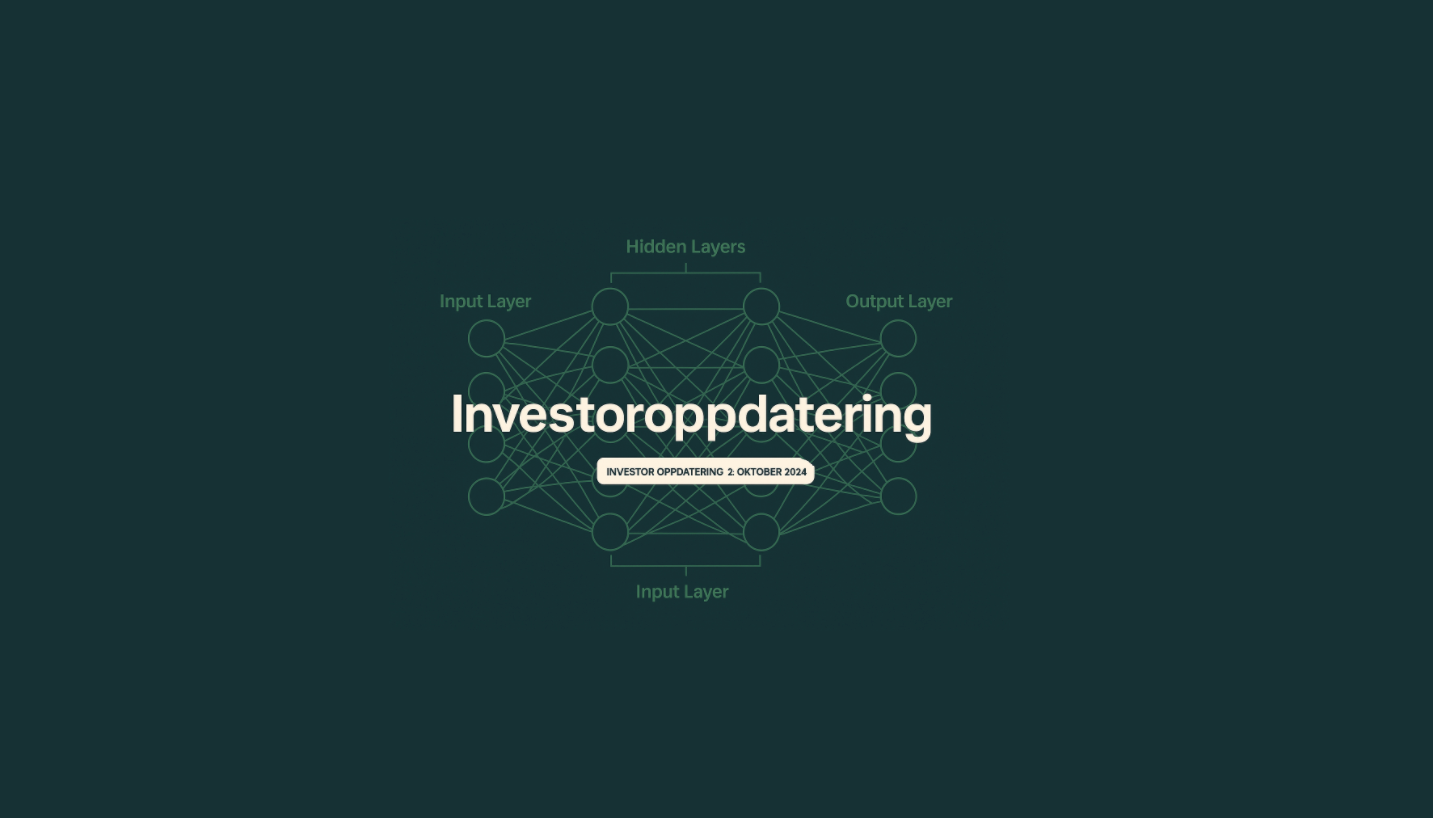
A neural network is a way for computers to learn by mimicking the way the brain processes information. The network learns by trial and error, and by adjusting the weights in the connections between neurons. The more quality data it receives, the better it becomes at finding patterns and predicting the correct answer.
- The input layer receives data, where each circle (or neuron) in this layer represents a variable or property in the data, such as acceleration in an axis, temperature, or location.
- Hidden layers process the data, combining the signals from the inputs in different ways. Each connection has a weight that tells how important it is, and the network automatically adjusts these weights as it learns – to reduce errors.
- The output layer provides the result, such as what the dog does or deviations from normal behavior.

Training our neural network
In order to train the network on a larger number of dogs, we have developed a data collection function in the app. Here, a Lildog is connected to video, so that the image and data are synchronized in time. This gives us large amounts of training data directly from our users that we can quality-assured using AI.


Training such a network takes time, which is why we are launching several new features in parallel to provide increased value to users and a better data base for us.
Four new features in Lildog
1. Tours
"Trips" is a new feature that allows the user to start, stop, save and share their walks with their dog. This was one of the core features of Telenor's "Mittspor", and after taking over their customer base, we have received a lot of demand for this particular feature.
The feature gives the user a more active role in interacting with Lildog – they can decide when a trip is recorded and how it is saved. This gives a sense of control, while also making the data more accurate.
The Walks feature records information such as distance, duration, location and route, providing a comprehensive picture of your dog's activity. Eventually, users will be able to share walks with friends, compare results and participate in simple challenges and competitions within the app.
We draw inspiration from platforms like Strava and other activity apps, and envision that “Trips” can become an important part of the Lildog experience – both as a social element and as a source of more detailed data for further development of health measurement and movement analysis.


2. Dead Reckoning
Dead Reckoning is a method where Lildog calculates its position based on previous speed, direction and movement – without retrieving new GPS data for each point. This allows for continuous position updates every second, without compromising battery life.
The development of this technology started with the first version of Lildog, but we learned early on that it required adjustments right down to the circuit board level to provide sufficient precision. With the technical improvements in Lildog 2, we now have the foundation to fully implement Dead Reckoning.
The method will provide a noticeably better user experience by creating a more realistic and coherent picture of the dog's movements. Instead of spotty GPS updates that often result in choppy tracks and inaccurate routes, Lildog will be able to show a smooth and precise history of where the dog has actually moved.
The figure below shows how the technology works in practice. The gray line shows the dog’s actual route (“Truth”), while the orange line shows the received GPS points without the use of filters or algorithms. When Dead Reckoning is combined with our existing filters and location algorithms, the device will be able to reconstruct the movement so that the location history appears as precise and smooth as the gray line.

Dead Reckoning also lays the foundation for several important improvements:
- More precise notifications , including in the Geofence function, where notifications occur the moment the dog crosses a virtual fence.
- A more coherent movement history , giving the owner better insight into the dog's activity.
- Updating the avatar in real time , so that the digital representation of the dog follows the movement seamlessly.
3. Geofencing
Geofence is a virtual fence that the user sets up on the map to define a safe area for the dog. When the dog moves outside this area, an alert is sent to the owner.
This feature was available in previous versions of Lildog, and most competitors today offer a similar solution. However, the challenge with traditional geofence features is the time delay between the dog actually crossing the boundary and the notification being sent. Typically, the GPS position is only updated after a certain interval, so the notification often arrives too late. This gives a false sense of security, and many users have previously experienced the feature delivering less value than expected.
Dead Reckoning solves a large part of this challenge. The technology makes it possible to calculate the dog's movement continuously between GPS updates. This means that the alert can be sent the moment the dog crosses the fence, without having to wait for the next GPS update.
The result is a far more precise and reliable feature that gives the owner real peace of mind. Geofence thus goes from being a standard security feature to becoming a highly valued tool in the daily use of Lildog.
4. Lost mode
Today's real-time tracking, "Live" mode, is often used by many throughout rides - or is left on constantly. The feature is built with several smart algorithms to reduce battery consumption, and therefore it does not always feel like true real-time tracking for users who really need fast updates. Recently, we have increased the update rate during normal use, and with Dead Reckoning, the device will soon be able to deliver real-time movement even without being in Live mode.
To make the feature clearer and more reliable, we are replacing the current “Live” mode with a new “Lost Dog” feature . This feature disables all battery-saving logic and sends GPS position continuously. This provides true real-time tracking – but is also very battery-intensive.
To avoid misuse, we place the feature behind a double confirmation, and we visualize that it is active by pulsing both the location and battery indicators. In addition, a clear message is displayed that the device is continuously searching for position.
We believe this upgrade makes it clear to users that the feature should only be used in real emergencies, and not in everyday use. When users are also given the ability to start their own walks in the app, "Lost Dog" mode will be used more often only when it is actually needed.

Lildog 3 – the next step in development
When Apple launched the first iPhone in 2007, it lacked many of the features we take for granted today – such as the App Store, 3G network, MMS, GPS, video recording, push notifications and support for third-party apps. Even simple functions such as copy/paste and Norwegian language support were not available. It was not until the third version, the iPhone 3GS, that it was launched in Norway and much of the rest of the world – with the seamless user experience that made the iPhone a global breakthrough.
This evolution is entirely natural. A product that combines hardware, software, and user experience at such an advanced level must mature over several generations. That's exactly how we see Lildog 3 .
So far, we’ve done a lot right: we’ve taken ownership of our IPR and the entire supply chain by designing, developing, and manufacturing everything from scratch. We’ve updated the service with features like precise location, history, activity level, temperature measurement, lights, sound, and a “lost dog” mode. We’ve also moved subscription purchases, cancellations, and upgrades directly into the app, simplifying the entire customer experience.
In parallel, we have improved the hardware, developed algorithms for data collection and analysis engines that interpret usage patterns – and established a neural network that, over time, will enable the device to "think" for itself.
Now we are using this knowledge, data and experience to develop Lildog 3 – our next flagship, designed to deliver the seamless and intelligent user experience that marks the transition from product to platform. This will be the foundation for our efforts in Europe, the US and eventually much of the world.
Lildog 2 has given us unique insights
In the book "Collaboration", Professor Morten T. Hansen analyzes the success factors behind Apple's breakthrough with the iPod. How was Apple – a small company at the time – able to crush the giant Sony and their completely dominant "Walkman" in the portable music player market?
The success criteria are mainly about collaboration across the different disciplines. While the mogul Sony competed internally and worked separately within the different disciplines, Apple was a small company that worked in small interdisciplinary teams to adapt the overall product continuously. It is concluded that this is why Apple had sold 100 million iPods and dominated 82 percent of the US market during the first five years.
This is relevant to us, because Lildog also works in small interdisciplinary teams to continuously develop the entire service. And now after the data collection from Lildog 2, this becomes even more important, as we see new ways to optimize communication and data flow down to the circuit board level to achieve a significantly different result in the service being delivered. A revelation that gives us the seamless user experience we have long had a vision of delivering.
We are aiming for a Lildog that thinks for itself, mirrors the dog in real time, detects illness and updates its precise location every second – with a battery life of up to 12 months. This will be an incremental advantage over our competitors and the Lildog we have always had a vision of delivering.
To achieve this, some new components and adjustments are required that further improve data flow at the circuit board level. At the same time, we are looking at several practical improvements:
- ability to turn the device on and off,
- wireless charging via mobile,
- adjustable light color,
- bark alert,
- an improved fastening mechanism,
- and a fully sealed Lildog that can withstand long-term use in saltwater.
The sum of these details will provide a better and more holistic experience for the user.
Lildog Leaps
In the 1970s, researchers studying chimpanzees discovered that their young did not become independent gradually, but through predictable developmental leaps . Later research showed that human children go through similar mental leaps, each of which marks a new phase in the child's development.
This research formed the basis for the book The Wonder Weeks , which describes how infants experience distinct periods of restlessness, regression and sleep difficulties – just before they learn something new. The book, which has sold over two million copies worldwide, was later turned into an app with more than four million downloads. The app acts as a developmental calendar that tells parents when their child, for example, begins to dream, perceive distance, recognise patterns or understand cause and effect – and provides concrete advice on how to best support their child through these phases.
The same principles apply to dogs. Together with dog trainer Hanne Trøan, who has mapped the twelve developmental leaps from puppy to adult dog, we have developed Lildog Leaps. The app conveys this knowledge in a practical and engaging way, along with advice and tips from veterinarians and dog trainers.
Lildog Leaps follows the dog's natural development and provides the owner with a calendar of the different phases the dog goes through:
- When your puppy starts chewing on everything and how to deal with it.
- When it tests boundaries and needs clear leadership.
- When the hunting instinct awakens, and how to channel it correctly.
- When puberty starts, and hormones affect behavior.
The goal is to provide dog owners with a simple and useful guide throughout their puppy's development - while learning to understand and follow their dog's needs in a new way.

Why we spend time on this
Since the beginning, we have known that the key to rapid growth lies in reaching dog owners early – right when the puppy leaves the breeder. If every puppy came with a Lildog device, we would quickly establish ourselves as the market leader.
The challenge is that the Lildog device itself does not provide much value for a small puppy. The initial period is about bonding between dog and owner – not about tracking. It is only when the dog becomes more independent and starts to explore that the need for GPS and activity tracking really arises. At the same time, it is logistically demanding to reach over 10,000 registered breeders in Norway alone, and far more internationally, with a physical product that requires follow-up.
With Lildog Leaps, we are solving this challenge in a completely new way. The app is free, easy to recommend, and requires no physical distribution. For breeders, it is a useful tool that provides additional value to their customers and helps new dog owners understand what to expect in the weeks and months after adoption.
The app provides ongoing tips and guidance from veterinarians and dog trainers, and becomes a natural support in the first phase of a dog's life. Breeders and trainers we have spoken to describe Lildog Leaps as a "must" for new owners - a simple, trustworthy place to get information, in a market otherwise characterized by advertising and fragmented advice.
Additionally, the app can be launched globally from day one, without geographical restrictions. Using AI, all content is automatically translated and video material is dubbed into local languages. This allows us to offer the same value to dog owners in every country – while introducing Lildog as a brand in a way that is both natural and valuable.
A gateway to the Lildog product
Through Lildog Leaps, dog owners receive alerts and guidance as their puppy develops. This ongoing follow-up provides reassurance, builds trust in the brand, and establishes a relationship with Lildog long before purchasing a device.
As the dog gets older and more active, its needs also change. In the phases of exploration, boundary setting, socialization, fear periods, puberty, hunting instinct and maturity, the need for overview and security becomes greater. Here Lildog naturally comes in as an aid that gives the owner control and insight into the dog's activity and health.
The app gradually introduces the owner to how Lildog can support at each stage – with tracking, activity tracking and health data. The user thus learns the value of the product over time, before making a purchase.
Lildog Leaps therefore acts as a natural gateway to the Lildog ecosystem – a channel that builds loyalty, understanding and purchase interest. This gives us a cost-effective path to new customers and a user base that already has a trusting relationship with the brand.
There are currently no similar apps or services on the market. In the future, we envision both the Lildog Leaps and Lildog Hotel apps being integrated into the Lildog app.
Compartir:
Investor update - sales - October
Investor Update - December