
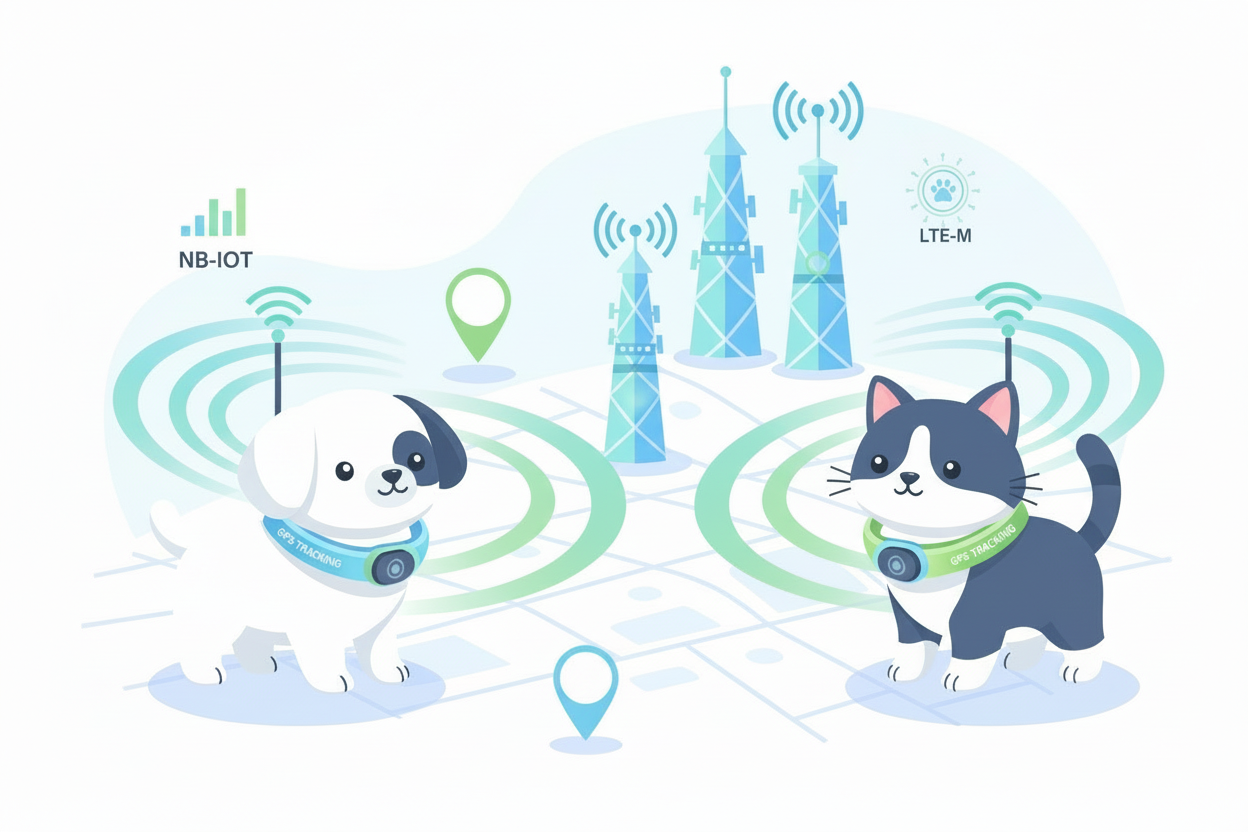
In Europe, both people and animals cross borders. Expectations are the same everywhere: technology should simply work – whether you are in a city, the countryside or traveling between countries. For GPS tracking of dogs and cats, this is challenging. Coverage conditions vary widely between countries, operators and environments.
This is why network technology is not a minor detail – it is the foundation. Lildog is built on NB-IoT (NarrowBand IoT) and LTE-M (Long Term Evolution for Machines), two global IoT standards operating within modern 4G and 5G networks.
Why Europe demands more from GPS tracking
Europe combines dense urban areas, older building structures, mountains, forests, coastlines and vast rural regions. Mobile networks differ between countries in operators, frequency usage and historical infrastructure.
A GPS tracker that works reliably across Europe must:
- handle highly variable coverage conditions
- operate in modern 4G and 5G IoT networks
- consume minimal power over long periods
- remain functional as legacy networks are phased out
NB-IoT and LTE-M were designed specifically for these requirements.
What are NB-IoT and LTE-M?
NB-IoT and LTE-M are global IoT standards within the 4G and 5G ecosystem. They are built for connected devices that require reliability, deep coverage and low power consumption rather than high bandwidth.
NB-IoT is optimized for extremely low energy usage and infrequent data transmission. LTE-M offers higher data rates and faster responsiveness while still maintaining good battery efficiency.
Why NB-IoT and LTE-M are ideal for dogs and cats
Tracking animals is very different from tracking smartphones. Dogs and cats often move through environments that are difficult for traditional mobile connectivity:
- indoors (homes, garages, basements, sheds)
- near concrete, metal and dense buildings
- in forests, fields and uneven terrain
- in rural or semi-rural areas
NB-IoT and LTE-M are designed to maintain stable communication in exactly these conditions, where older technologies frequently fail.
Coverage in challenging environments
IoT-optimized 4G and 5G networks are engineered for improved signal penetration and reliability in difficult environments. This increases the likelihood that a tracker can transmit its location even when conditions are far from ideal.
For pet owners, this translates into more reliable location updates when it actually matters.
Battery life is not optional
A tracker that needs frequent charging quickly becomes impractical. NB-IoT is optimized for minimal power consumption when sending data at intervals, while LTE-M allows more active communication without destroying battery life.
Longer battery life means the device stays on the pet – and stays operational.
Europe is moving away from 2G
Across Europe, legacy networks such as 2G and 3G are being phased out or deprioritized. GPS trackers that rely solely on 2G face increasing reliability issues and eventual loss of service.
By using NB-IoT and LTE-M within the 4G and 5G ecosystem, Lildog aligns with the direction European mobile networks are moving.
Summary
- NB-IoT and LTE-M are global IoT standards in 4G/5G networks
- Well suited for Europe’s diverse coverage conditions
- More reliable in indoor, rural and challenging environments
- Lower power consumption and longer battery life
- More future-proof than GPS trackers dependent on 2G
For dog and cat owners, this means GPS tracking designed for real European conditions – not marketing fantasies.
FAQ
What is NB-IoT?
NB-IoT is an IoT standard optimized for low power consumption, deep coverage and reliable communication for battery-powered devices.
What is LTE-M?
LTE-M provides higher data rates and faster response than NB-IoT while still maintaining good energy efficiency.
Why is this important for pet tracking?
Pets move through environments with poor or inconsistent coverage. NB-IoT and LTE-M are designed to function reliably in those conditions.
Is NB-IoT and LTE-M available across Europe?
They are global standards used by many European operators. Availability varies by country, but the technologies are designed for international use.
Why is 2G a problem?
2G networks are being phased out across Europe. Trackers that rely on 2G risk reduced reliability or complete loss of service.
Share:
Lildog GPS vs. AirTag – What’s the Best Tracking Option for Dogs and Cats?
Dog Breeds That Don’t Shed: 15 Clean Companions for Your Home