
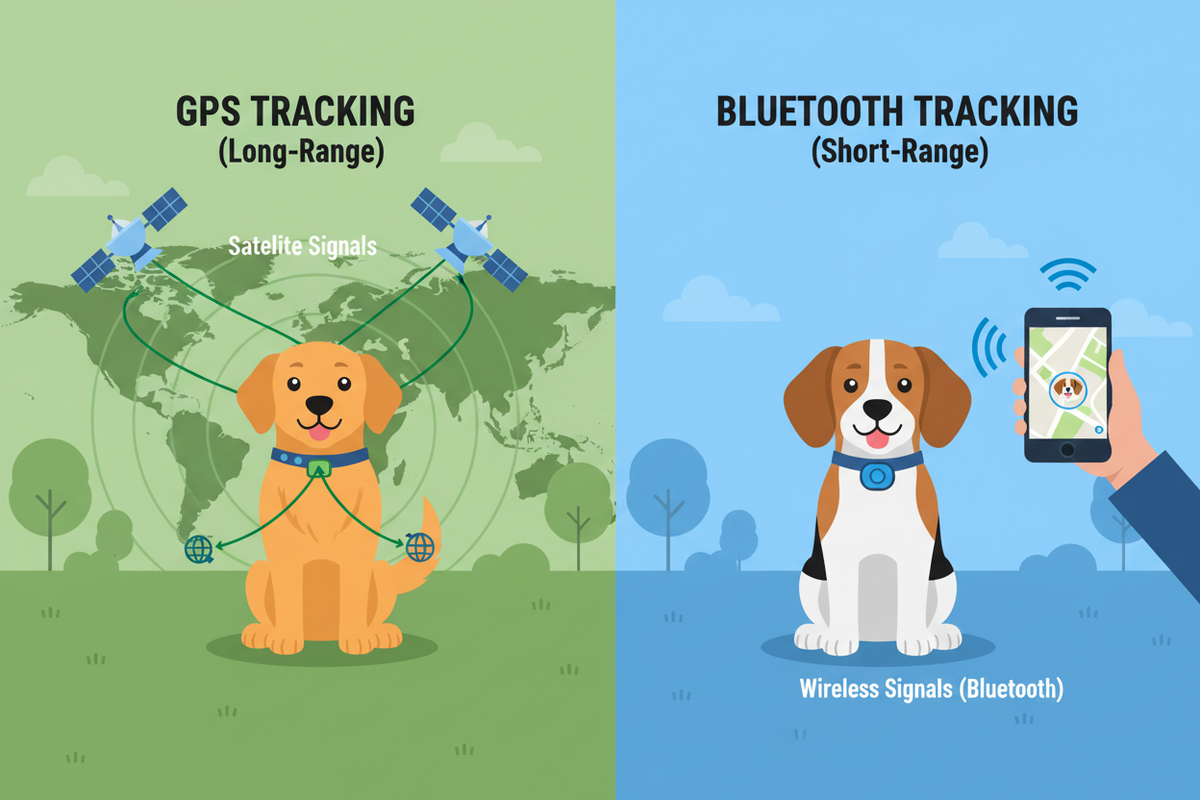
A tracker for your dog or cat can be small, affordable and easy to attach to a collar. But two tags that look similar can offer very different help when your pet disappears from view.
A Bluetooth tag can help you find something nearby. A network tag such as an AirTag can be detected by other phones. A GPS tracker with mobile connectivity can calculate its own position and send it to you from a distance. That difference becomes particularly important when a dog keeps running or a cat moves into an area with few people.
This guide explains what these technologies actually do, their limitations and what to check before choosing a tracker for your pet.
Quick answer: If you want new location updates when your dog or cat is outside your phone’s range, GPS with mobile connectivity is usually the most relevant option to investigate. It needs battery power, satellite reception and mobile coverage. Bluetooth tags can help with nearby searches; network tags can also provide locations from a distance when compatible devices detect them.
GPS, Bluetooth and mobile networks have three different jobs
The word “tracker” tells you little about how a product works. It might mean a tag your phone detects nearby, or a device that calculates its position and sends it through a mobile network. Look for answers to two questions: How does the device determine its location, and how does that information reach your phone?
- GPS/GNSS determines the position. A receiver uses satellite signals to calculate where it is. GNSS is the collective term for satellite navigation systems, of which GPS is one.
- Bluetooth connects devices within range. A phone can detect a nearby tag. What the app displays depends on the product’s features.
- A mobile network can transmit the position from a distance. A connected tracker sends data to a service that makes it available in your app.
A device can therefore have GPS without being able to send you new map locations when it is far away. And a tag can appear on a map without having GPS, because other devices have detected it. The map alone does not tell you which technology was used.
We explain how these parts work together in our article on how GPS tracking for dogs and cats works.
What can a Bluetooth tag for a dog or cat do?
A basic Bluetooth tag transmits a radio signal your phone can detect when the two devices are close enough. Depending on the model, you may receive a proximity notification or be able to play a sound on the tag. This can help if your cat is hiding nearby or you’re looking for a collar that has gone missing at home.
When the tag moves outside direct range, your phone loses that connection. An app may still show the place where the connection was last available, but that does not mean your pet is still there. Check how the particular model displays “last seen” information and loss of connection.
How far does Bluetooth reach?
There is no single range figure that applies to every Bluetooth product. The radio, antennas, phone, surroundings and obstacles affect the connection. An advertised range in open terrain may therefore be greater than what you experience between houses, behind walls or in dense vegetation.
Bluetooth SIG, the organisation behind the technology, explains how equipment and obstacles affect Bluetooth range in practice.
For a pet, the question is therefore not just how far the signal reaches under good conditions. Also ask: What does the tag do when your dog or cat is outside its range? If it has no other way to report its location, you need to get close enough again yourself.
AirTag and other network tags: location through nearby devices
A network tag builds on Bluetooth. Compatible devices passing nearby can detect its signal and report a location to the owner. This means the tag can appear on a map even when it is far from your own phone.
AirTag uses Apple’s Find My network. Apple explains that this network uses Bluetooth to detect accessories and report their approximate location. AirTag has no GPS or mobile connection of its own. Read Apple’s explanation of how the Find My network helps locate belongings.
This can provide useful information. The limitation when using it on a moving animal is that new detections depend on participating devices coming close enough. A busy street and a quiet woodland path do not necessarily offer the same opportunities for updates.
When you are nearby yourself, sound and Precision Finding can help with compatible equipment. These features for searching at close range do not give the tag its own connection for continuously sending locations from a remote place. Features and compatibility vary between models.
It is therefore too simplistic to say an AirTag “only works near your phone”, but also misleading to treat a map detection as guaranteed live tracking. Read our comparison of AirTag and GPS for dogs and cats if you are considering that choice.
How does a GPS tracker work when your pet is far away?
A GPS tracker with mobile connectivity calculates its position using satellite signals and sends it through a mobile network. It does not need to be detected by a phone belonging to someone who happens to pass nearby.
The distance to your own phone is not limited by direct Bluetooth contact. That does not mean every place has coverage, however. The device must support the mobile network and service in the area and have an available connection to send new positions.
GPS reception and mobile coverage are two different things
Satellite reception affects whether the tracker can calculate a good position. The mobile connection affects whether it can transmit that position. The device can have problems with one while the other works.
Buildings, indoor use and trees can affect GPS reception, including by blocking or reflecting signals. GPS.gov explains these factors in its overview of what affects GPS accuracy.
How often you receive new positions also depends on the settings and battery. “Real time” should therefore be assessed alongside the update interval and the time of the last recorded position. If the tracker loses its connection, check how the app displays this and what happens when the connection returns.
GPS or Bluetooth: comparing the options for dogs and cats
The table distinguishes between direct Bluetooth searches, Bluetooth through a network and GPS with mobile connectivity. A tracker can combine several of these technologies.
| Feature | Basic Bluetooth tag | Network tag, such as AirTag | GPS with mobile connectivity |
|---|---|---|---|
| How it determines or reports location | Your phone detects the tag within direct range. | Devices in the network detect the tag and report a location. | The tracker calculates a satellite position and sends it through a mobile network. |
| When your pet is far from you | No direct contact until you get close enough again. | Can provide a new detection if a compatible device passes close enough. | Can send new positions where the necessary reception and coverage are available. |
| What updates depend on | Distance to your phone, equipment and obstacles. | Contact with participating devices in the network. | Satellite reception, mobile coverage, battery and settings. |
| Battery | Often low power consumption; varies by model and use. | Often long battery life; check the model and battery type. | Usually needs more frequent charging because positioning and data transmission use power. |
| Ongoing costs | Often no mobile subscription; check for any app fees. | Often no mobile subscription of its own; terms vary. | The mobile connection and service often carry an ongoing cost. |
| Particularly relevant for | Searching for something nearby. | Finding something when the network can detect the tag. | Location updates from pets outside the owner’s direct range. |
What does the difference mean when you’re actually searching?
Your cat is hiding close to the house
If your cat is within range, a tag with sound can help you search nearby. A map position will not necessarily tell you whether the cat is under the decking, behind a bush or inside the shed. Proximity searches and a calm, thorough search are useful additions here.
Your dog keeps running from the place where you last saw them
New detections then become more important than the place where contact was lost. Direct Bluetooth contact disappears when the distance becomes too great. A network tag needs participating devices to detect it, while a GPS tracker with mobile connectivity can send positions even where those devices do not pass, provided reception and coverage are available.
If your dog is already missing, you can find practical advice in our guide to what to do when your dog runs away.
You see a dot on the map, but no new updates
Start with the time of the recorded position. An earlier location can be a useful starting point for a search, but does not necessarily show where your pet is now. This applies both to network tags and to GPS trackers that have been unable to send new data.
Check the time, not just the map dot. Assess the age of the position alongside connection status and any accuracy information. This helps you understand what the app actually knows.
Battery life and subscriptions: what do you get for the difference?
A Bluetooth tag can often last a long time on a small battery because it does not need to calculate and transmit its own GPS positions through a mobile network. A GPS tracker uses more energy, particularly when it does this frequently.
Comparing battery life alone is therefore less useful. Also look at how often you receive new positions and how they reach you. A long-lasting battery does not solve the need for fresh updates if the tag is not detected where your pet is.
Lildog lists a battery life of 3–5 days, depending on use, on the Lildog 2 product page. This is not a guarantee for every situation. Frequent location updates, signal conditions and settings affect how often you need to charge it. Read more about what affects GPS tracker battery life.
Why do GPS trackers often need a subscription?
You are not paying for the satellite signals themselves. A subscription can cover mobile connectivity, data traffic and access to tracking features in the app. Check what is included with the product you are considering.
Compare the total cost: device, holder, service and any charges after an included period. For Lildog and Lilcat, the current terms are available on the subscriptions page.
Why do Lildog and Lilcat combine GPS, Bluetooth and mobile connectivity?
GPS and Bluetooth can complement each other in the same product. Bluetooth provides contact when the tracker is close to your phone, while mobile connectivity can transmit location data when your pet is farther away. The satellite receiver makes it possible to calculate a GPS position.
Lildog 2 and Lilcat 2 combine these technologies. The mobile connection uses NB-IoT and LTE-M. You can read about how NB-IoT and LTE-M transmit the GPS position if you want to understand the difference between satellite reception and network connectivity.
The purpose of this combination is to use different connections according to the situation. It does not remove the need for battery power or coverage, nor does it make every map position error-free.
See the features and product information for Lildog 2 for dogs and Lilcat 2 for cats when comparing options.
Checklist: choosing a tracker for your dog or cat
Choose according to the situation you need help with. Searching at home, receiving new positions from an outdoor cat and finding a dog that has run a long way all place different demands on a tracker.
- Tracking at a distance: Can the device send new positions without contact with your phone or a random passer-by?
- Age of the position: Does the app clearly show when your pet was last recorded?
- Coverage: Are the areas and countries where you plan to use the tracker supported?
- Updates: What is the normal interval, and is there a feature for more frequent updates when you’re searching?
- Battery: Does the charging schedule fit your routine, and do you receive a warning before the battery runs out?
- Comfort: Assess the total weight and size with the holder, not just the tag itself.
- Attachment: Does the device sit securely on the collar or harness without getting in your pet’s way?
- Phone and app: Is the product compatible with your phone, and can tracking be shared with other people who look after your pet?
- Total cost: What will the device and service cost over the time you expect to use them?
For cats, collar fit and a safety release are important. Cats Protection recommends a properly fitted collar with a buckle that opens if the cat gets caught. Read its advice on choosing a cat collar.
If you mainly need help finding something nearby, Bluetooth may be enough. If you want new positions when your pet is far away, investigate GPS with mobile connectivity. A network tag can provide useful clues, but its updates depend on the network detecting it. None of these solutions can guarantee that a missing pet will be found.
Frequently asked questions about GPS and Bluetooth for dogs and cats
What is the difference between a GPS tracker and a Bluetooth tag?
A GPS tracker calculates a satellite position. With mobile connectivity, it can send that position to the app from a distance. A basic Bluetooth tag is detected by your phone within direct range. Network tags can also be detected by other compatible devices.
Can I track my dog with a Bluetooth tag?
You can use it to detect the tag nearby, and some models can report detections through a network. When your dog moves outside range, new updates depend on the tag having another way to report its location. Investigate this before choosing it as an aid if your dog escapes.
Does AirTag work far from my own phone?
Yes. An AirTag can provide a position far from your phone when a compatible device in the Find My network detects it. This is not the same as the AirTag calculating and sending a GPS position itself. New detections depend on contact with the network.
Does GPS work without mobile coverage?
A GPS receiver can calculate its position without mobile coverage if satellite reception is sufficient. A tracker that uses mobile connectivity still needs an available connection to send new data to the app. Whether positions are stored and transmitted later depends on the product.
Do GPS trackers have unlimited range?
GPS with mobile connectivity is not limited by the direct Bluetooth distance to the owner’s phone. In practice, tracking is still limited by supported networks and countries, coverage, satellite reception and battery power. Check where the service actually works.
Do Lildog and Lilcat use Bluetooth or GPS?
They use both, together with mobile connectivity. Bluetooth provides contact nearby, GPS calculates the satellite position, and the mobile network can transmit data when your pet is outside direct range.
Why does a Bluetooth tag’s battery often last longer?
A basic Bluetooth tag usually uses less power than a device that calculates satellite positions and transmits them through a mobile network. Compare battery life with the type of updates you need, and check the information for the particular model.
Share:
GPS tracker battery life for dogs and cats: Get more from each charge
What Should You Do If Your Dog Runs Away? A Realistic Guide When It Happens