
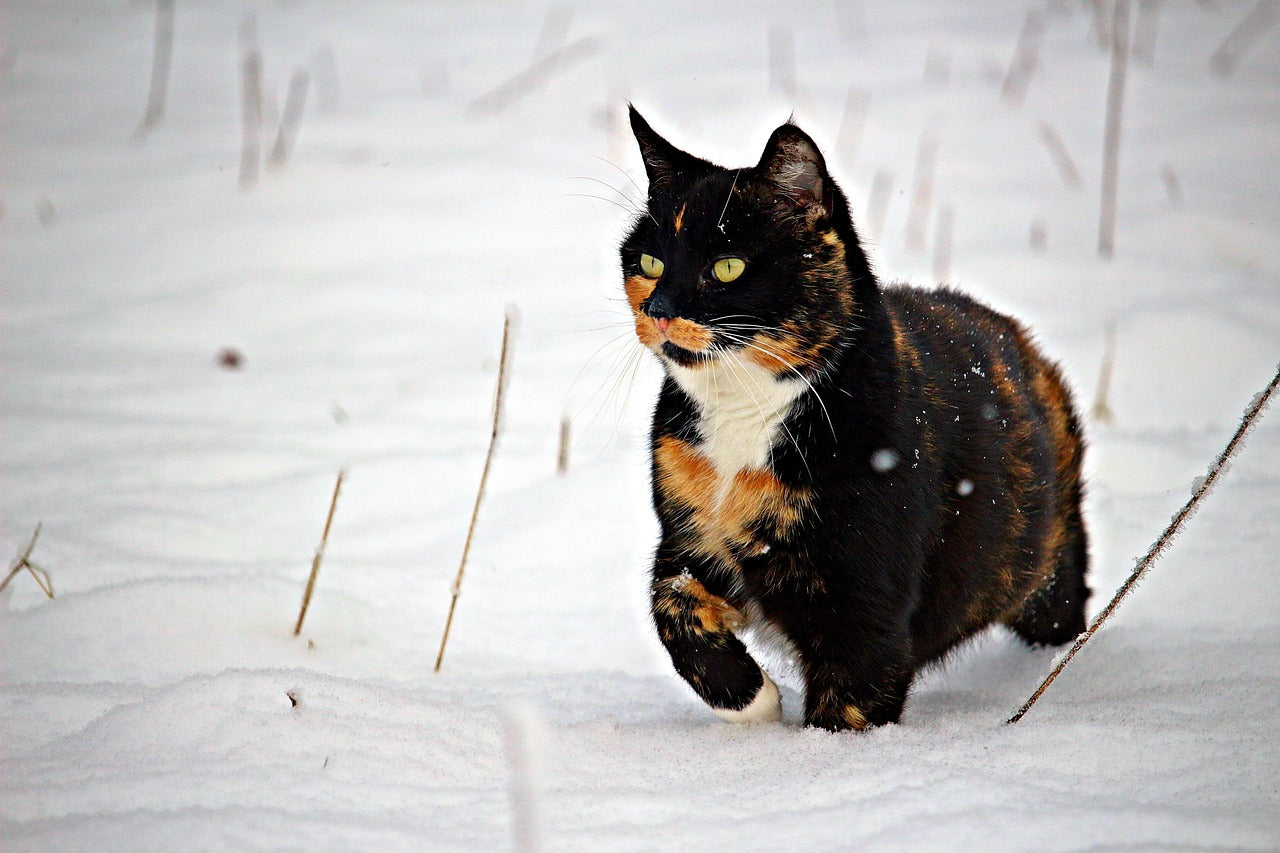
Tricolor Cat (Calico) – Why Are Almost All of Them Female?
The tricolor cat, also known as a calico cat, is not a cat breed. Instead, it is a unique coat pattern that can appear in many different breeds. A typical tricolor cat has three distinct coat colors: white, black and orange.
What makes tricolor cats especially fascinating is the genetics behind their colors. Nearly all calico cats are female, while male cats with a tricolor coat are extremely rare. In this guide, you'll learn why that happens, what separates calico from tortoiseshell cats, which breeds can have a tricolor coat, and why these cats are considered symbols of luck in many cultures.
What Is a Tricolor Cat?
A tricolor cat is a cat with three distinct colors in its coat. The term calico is commonly used in English-speaking countries. The important thing to understand is that tricolor does not describe a breed—it describes a coat pattern.
That means a tricolor cat can be a domestic shorthair, Maine Coon, Persian, Norwegian Forest Cat or many other breeds. The coat pattern is determined by genetics rather than breed.
The classic tricolor pattern combines white, black and orange patches. Some cats have large blocks of color, while others have many smaller markings spread across the body. Certain cats display softer shades such as cream, red or blue-gray variations.
For centuries, tricolor cats have been associated with luck, prosperity and folklore. Their striking appearance and the rarity of male calico cats have helped create countless myths and legends around the world.
In Irish folklore, it was even believed that a calico cat's tail could cure warts, although this should definitely not be considered medical advice.
Tricolor Cat Facts
| Other names | Calico, three-colored cat |
| Breed? | No, it is a coat pattern |
| Typical colors | White, black and orange |
| Gender | Almost always female |
| Male cats | Extremely rare and often infertile |
| Personality | Varies between individuals |
| Breeds | Can occur in many cat breeds |
| Symbolism | Often associated with luck and prosperity |
The table above summarizes the most important facts. A tricolor cat is not a special breed with a specific personality—it is primarily a unique genetic coat pattern.
What Colors Does a Tricolor Cat Have?
For a cat to be classified as a tricolor or calico cat, it generally needs three clearly visible colors in its coat. The most common combination is white, black and orange.
There are also several variations. Some cats display cream, red, brown or blue-gray shades. These softer colors still qualify as tricolor patterns as long as three distinct color groups are visible.
White plays an important role in the classic calico appearance. White patches typically separate the black and orange areas, making the coat pattern stand out more clearly.
Common tricolor color combinations include:
- White, black and orange
- White, brown and red
- White, blue-gray and cream
- White, black and cream

The combination of three clearly defined colors is what makes calico cats so recognizable. No two cats have exactly the same pattern, making every tricolor cat completely unique.
Why Are Almost All Tricolor Cats Female?
One of the most fascinating things about tricolor cats is that their coat pattern is directly connected to genetics and sex chromosomes. To understand why almost all calico cats are female, we need to look at how coat colors are inherited.
The gene responsible for orange fur is located on the X chromosome. Female cats have two X chromosomes (XX), while male cats have one X chromosome and one Y chromosome (XY).
A female cat can inherit an orange color gene from one parent and a black color gene from the other. During development, one X chromosome becomes active in some cells while the other X chromosome becomes active in others. This creates a mosaic effect, producing distinct patches of black and orange fur.
If the cat also inherits the gene responsible for white spotting, the result is the classic calico pattern with white, black and orange areas.
This unique combination of genetics explains why tricolor coats occur almost exclusively in female cats.
Author Laura Gould explores this subject in greater detail in her book Cats Are Not Peas, which examines feline genetics and the science behind coat colors.
Many people are surprised to learn that a calico cat's striking appearance is actually a visible expression of complex genetic processes happening at the cellular level.

How Rare Is a Male Calico Cat?
Male calico cats are exceptionally rare. It is commonly estimated that only about one in every 3,000 calico cats is male.
For a male cat to display both black and orange fur at the same time, a genetic anomaly is usually required. Instead of the typical XY chromosome combination, these cats often possess XXY chromosomes.
This additional X chromosome allows the cat to carry both the orange and black coat color genes, making the tricolor pattern possible.
Most male calico cats with XXY chromosomes are sterile and cannot reproduce. However, they can still live long, healthy and happy lives as companion animals.
Because of their rarity, male calico cats are often viewed as extraordinary animals. In some cultures they are considered especially lucky and highly valuable.
If you ever meet a genuine male calico cat, you've encountered one of the rarest coat-color combinations found in domestic cats.
What Does a Tricolor Kitten Look Like?
A tricolor kitten can often be identified shortly after birth. Most kittens display visible white, black and orange patches from an early age.
However, coat colors may continue to develop as the kitten grows. Orange patches can deepen in color, darker markings may become more defined, and subtle shades often become more noticeable during the first months of life.
In long-haired breeds, the pattern can become even more impressive once the adult coat fully develops.
Many cat owners quickly fall in love with the unique appearance of calico kittens. No two tricolor kittens have exactly the same markings.
Just like fingerprints in humans, every calico cat's coat pattern is completely unique.
Tricolor Cats Around the World
For centuries, tricolor cats have been associated with luck, prosperity and protection in cultures across the globe.
In Japan, calico cats are among the most famous lucky animals. The iconic Maneki-neko, often called the "beckoning cat" or "lucky cat," is frequently depicted with a tricolor coat.
Many people believe these cats attract good fortune, business success and financial prosperity.
Historically, sailors in several countries also kept tricolor cats aboard ships. They believed the cats could protect vessels from storms, accidents and misfortune during long sea voyages.
Irish folklore contains stories about magical properties attributed to calico cats, further strengthening their reputation as special and fortunate animals.
Even today, many cat lovers consider tricolor cats symbols of positivity, good luck and happiness.
Calico vs Tortoiseshell
Both calico and tortoiseshell describe coat patterns rather than cat breeds. Because both patterns contain black and orange coloring, they are often confused with one another.
The primary difference lies in the amount of white fur present.
- Calico: Distinct patches of white, black and orange.
- Tortoiseshell: Primarily black and orange fur blended together, usually with little or no white.
Calico cats tend to have clearly separated color blocks, while tortoiseshell cats display a more blended, marbled appearance.
Both patterns rely on the same genetic mechanism that allows black and orange fur to appear on the same animal.
Like calico cats, tortoiseshell cats are also overwhelmingly female due to the genetics involved.
Which Cat Breeds Can Be Tricolor?
Because tricolor is a coat pattern rather than a breed, it can appear in many different types of cats. Some breeds are more commonly associated with the pattern than others.
Popular cat breeds that can display tricolor coloring include:
- Domestic Shorthair
- American Shorthair
- Persian
- Maine Coon
- Japanese Bobtail
- Norwegian Forest Cat
The Norwegian Forest Cat often showcases the tricolor pattern particularly well thanks to its long, thick coat. The distinct color patches can become especially striking as the adult coat develops.
Maine Coons are another breed where calico coloring appears relatively frequently. Their large size and luxurious coat can make the tricolor pattern especially impressive.
The Japanese Bobtail has perhaps the strongest historical connection to calico cats. Many traditional depictions of the famous Maneki-neko are believed to have been inspired by tricolor Japanese Bobtails.

It's important to remember that breed does not determine whether a cat becomes tricolor. The coat pattern is determined by genetics.
Do Tricolor Cats Have a Special Personality?
One of the most common questions about calico cats is whether they share a unique personality. Many owners describe their tricolor cats as especially confident, independent, affectionate or strong-willed.
Online, you may even come across the phrase “calico attitude”, used to describe cats that seem particularly determined or full of character.
Despite these stories, there is currently no scientific evidence proving that calico cats have a specific personality simply because of their coat color.
A cat's temperament is influenced by many factors, including:
- Genetics
- Breed
- Socialization
- Environment
- Life experiences
- Relationship with humans
This means some calico cats may be extremely affectionate while others are more independent. Some enjoy constant attention, while others prefer quiet surroundings and personal space.
The striking appearance of tricolor cats may simply make owners pay closer attention to their behavior, helping fuel the myths surrounding the famous "calico attitude."
How Much Does a Tricolor Cat Cost?
Many people search for terms like “tricolor cat price” or “calico cat cost,” but there is no fixed price for a calico cat.
The reason is simple: tricolor is not a breed. The cost depends on the breed, breeder, pedigree and overall background of the cat.
A tricolor domestic cat may be available for adoption through a rescue organization or shelter for a relatively modest fee. A calico kitten from a sought-after pedigree breed can cost significantly more.
Factors that influence the price include:
- Breed
- Pedigree
- Breeder reputation
- Health testing
- Demand
- Country and region
When choosing a cat, health, temperament and responsible breeding practices should always be more important than coat color alone.
A beautiful calico pattern may catch your eye, but the best cat is the one whose personality and needs fit your home and lifestyle.
Did You Know Many Cats Visit More Than One Home?
Studies and experiences from cat owners show that many outdoor cats do not spend all their time around their own home. Some regularly visit neighbors, explore large territories or stop at multiple locations during their daily adventures.
Because of this, more cat owners are turning to GPS tracking to better understand where their cats actually spend their time.
With the Lilcat 2 GPS Tracker for Cats, you can monitor your cat's movements in real time, view location history and discover favorite places your cat likes to explore.
Many owners are surprised to learn just how far their cat travels during a typical day.
What Do You Remember From the Article? – Take the Quiz!
Test your knowledge of tricolor cats with these questions based on what you've just learned.
Is tricolor a cat breed?
No. Tricolor, or calico, is a coat pattern that can occur in many different cat breeds.
What three colors are typically found on a classic calico cat?
White, black and orange.
Why are almost all tricolor cats female?
Because the gene responsible for orange fur is located on the X chromosome, and female cats have two X chromosomes.
How rare are male calico cats?
It is estimated that only about one in every 3,000 calico cats is male.
What chromosome combination do many male calico cats have?
XXY instead of the usual XY chromosome pattern.
Are most male calico cats fertile?
No. Most are sterile due to their genetic condition.
What is the difference between a calico and a tortoiseshell cat?
Calico cats have distinct white areas alongside black and orange coloring, while tortoiseshell cats typically have little or no white.
Is there scientific proof that calico cats have a special personality?
No. Personality is influenced by genetics, environment, experiences and socialization rather than coat color alone.
Which famous Japanese figure is often depicted as a calico cat?
The Maneki-neko, also known as the lucky cat or beckoning cat.
Can a Norwegian Forest Cat be tricolor?
Yes. The tricolor pattern can occur in Norwegian Forest Cats as well as many other breeds.
Can a Maine Coon be a calico cat?
Yes. Calico coloring is relatively common in Maine Coons.
Is a cat's price determined by the tricolor pattern alone?
No. Breed, pedigree, health and breeder quality are much more important factors.
Share:
Hypoallergenic Dogs: 15 Dog Breeds Often Better Suited for Allergy Sufferers
New Puppy at Home? How a GPS Dog Tracker Brings You Peace of Mind