
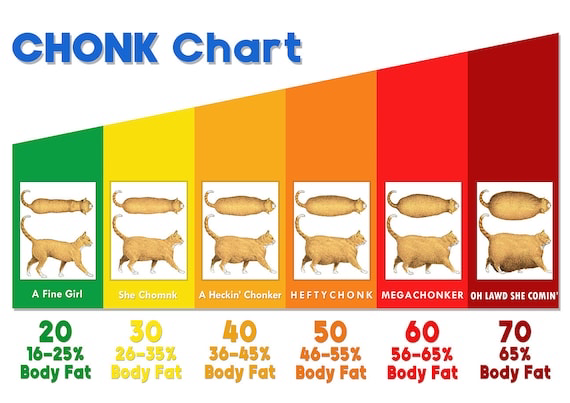
Chonk Chart for Cats: How to Tell if Your Cat Is Overweight
The Chonk Chart turned different cat body sizes into an internet meme, from A Fine Boi to Oh Lawd He Comin. It is funny, but it is not a tool for diagnosing obesity. A cat may look round because of its fur, posture or primordial pouch, while another cat may carry excess body fat without looking particularly large.
For a more useful assessment, veterinarians use a body condition score, or BCS. This is a standardized system that combines visual assessment with what you can feel when checking the cat's ribs, waist and abdomen.
Quick answer
On the WSAVA nine-point body condition scale, a cat is generally considered to be in ideal condition at around 5/9: the ribs can be felt beneath a thin layer of fat, a visible waist can be seen behind the ribs, and the abdominal fat pad is small. A photograph or a number on the scales is not enough to determine whether a cat is overweight. If you suspect your cat is carrying excess weight, ask your veterinarian to confirm the body condition score and create a gradual weight-loss plan if needed.

What is the Chonk Chart?
The Chonk Chart is a humorous classification that originated online. It gives increasingly exaggerated names to photographs of cats that appear progressively more substantial. Its popularity comes from something many cat owners recognize: the loaf-like posture, fluffy fur and serious expression of a round-looking cat.
The problem begins when a meme is used instead of a health assessment. Photographs can look very different depending on the camera angle, breed, coat length and position of the body. In addition, affectionate terms such as chonky can sometimes make weight gain seem more normal than it should.
The goal is not to shame the cat or its owner. Body weight can change for many reasons, and identifying a trend early makes it easier to address the problem safely.
The Body Condition Score for Cats: From 1 to 9
The World Small Animal Veterinary Association (WSAVA) publishes a nine-point body condition scoring system for cats. The middle of the scale, 5/9, generally represents ideal body condition. Lower scores indicate a condition below ideal, while higher scores indicate progressively more body fat.
| Approximate score | What you may see or feel | Interpretation |
|---|---|---|
| 1–3/9 | Ribs are very easy to see or feel, the waist is pronounced and there is little or no abdominal fat. | Below ideal body condition. |
| 4–5/9 | Ribs are easy to feel with little fat covering, the waist is visible and the abdominal fat pad is minimal. | Ideal body condition for most cats. |
| 6/9 | Ribs can still be felt but have slightly more fat covering; the waist and abdominal fat pad are present but less defined. | Slightly above ideal body condition; this may be acceptable in some cats, particularly older cats, depending on the individual assessment. |
| 7/9 | Ribs are more difficult to feel, the waist is less visible and the abdomen appears somewhat rounded. | Overweight. |
| 8–9/9 | Ribs are difficult or impossible to feel, the waist is absent and abdominal and lumbar fat deposits are clearly visible. | Obesity or significant excess body fat. |
Muscle mass should be assessed separately. A senior cat can lose muscle while gaining body fat at the same time, meaning that the number on the scales does not tell the whole story.
How to Tell if Your Cat Is Overweight at Home
Check your cat while it is standing and relaxed. Do not press firmly on the abdomen or force the cat into a particular position.
A three-step check
- Feel the ribs. You should be able to find them easily beneath a thin layer of fat without having to press firmly.
- Look from above. An ideal body condition usually has a gentle waist behind the ribs. Long or thick fur can make this harder to see.
- Look from the side. Assess the shape of the abdomen, but do not automatically mistake the primordial pouch for obesity.
Repeat the assessment regularly and look for changes rather than relying on a single impression. If you are unsure between two scores, your veterinarian can show you how to assess body condition correctly and record a baseline BCS.
Primordial Pouch or Abdominal Fat: They Are Not the Same
Many cats have a loose flap of skin and tissue that hangs in front of the hind legs. This is known as the primordial pouch, and it can swing from side to side when a cat walks even when the cat is at a healthy body condition.
The pouch itself does not indicate that a cat is overweight. A proper assessment should consider the ribs, waist, overall body shape, fat deposits and muscle mass together. This is why a side-on photograph of a cat's abdomen is not enough to determine its body condition.
Why Do Cats Gain Weight?
Body fat increases when energy intake consistently exceeds energy expenditure, but several different factors can contribute to this imbalance:
- feeding larger portions than the cat needs;
- leaving food available throughout the day;
- treats, leftovers or supplements that are not included in the daily intake;
- multiple people feeding the same cat;
- access to other pets' food bowls;
- reduced activity, boredom or too few opportunities to play;
- changes associated with age, neutering or lifestyle;
- pain or illness that reduces movement;
- medications or medical conditions that affect appetite or body weight.
A reduction in activity should not automatically be interpreted as laziness or simply as a consequence of being overweight. Joint pain, illness, stress, weather or changes in territory can also affect a cat's behaviour and activity levels.
When Your Cat Has More Than One Household: Extra Food Outside the Home
Some outdoor cats regularly visit other homes and may be offered food. This can be one possible explanation when portions at home are carefully controlled but the cat is not losing weight. However, it should not be assumed without further information.
An additional source of food can turn a small reduction in your cat's meals at home into a daily calorie surplus.
Before blaming the “neighbour with the snacks”, check everything your cat eats at home: treats, shared food bowls and food given by different members of the household. If your cat regularly visits another home, speak to the neighbours politely. Explain that your cat is following a veterinary weight-management plan and ask them not to feed it.
You can also use a lightweight tag with a message such as “Please don't feed me”, provided the collar is specifically designed for cats, has a safety release mechanism and is fitted correctly.
Can GPS Help You Find Out Where Your Cat Eats?
A GPS tracker can show your cat's movements, locations and how long it remains in particular areas. If your cat repeatedly appears near another home, this information may help you start a conversation with the people living there.
What GPS data cannot prove
A stop at a particular location does not prove that your cat has eaten there. It could be resting, hunting, hiding or simply watching what is happening around it. A GPS tracker also cannot measure calorie intake, diagnose obesity or replace a veterinary examination.
Movement history can be useful as one additional part of monitoring your cat. A sustained reduction in activity may be worth investigating, but it should be considered alongside body weight, body condition, age, weather, mobility and behaviour.
With the Lilcat 2 GPS tracker for cats, you can check your cat's location and movement history. Use this information to better understand your cat's routines, not as a medical diagnostic tool.
Health Risks Associated with Overweight and Obesity in Cats
Excess body fat is not simply a cosmetic issue. It can reduce mobility and quality of life and is associated with health problems that require prevention and veterinary monitoring.
| Health concern | Why it matters |
|---|---|
| Diabetes mellitus | Obesity is an important risk factor. Treatment may involve dietary changes, monitoring and veterinary medication. |
| Osteoarthritis and reduced mobility | Additional body weight can increase the load on the joints. Pain can also reduce activity, creating a difficult cycle to break. |
| Difficulty grooming | Some overweight cats have difficulty reaching certain areas of their body, which can contribute to matted fur and skin problems. |
| Reduced tolerance for exercise and heat | Additional body fat can make movement more difficult and increase the physiological strain on the body. |
| Risks associated with inappropriate weight loss | Severe calorie restriction or stopping food intake can contribute to hepatic lipidosis, a potentially life-threatening condition. |
How to Help Your Cat Lose Weight Safely
The first step is to confirm that your cat actually needs to lose weight. A veterinarian can rule out underlying medical conditions, record body weight and muscle mass, assign a body condition score and establish a realistic target.
- Use a measured daily portion. Measure the total amount of food your cat receives each day, preferably using a kitchen scale. Measuring cups can introduce significant inaccuracies.
- Count everything your cat eats. Include treats, food used to give medication, leftovers and anything your cat manages to eat from other food bowls.
- Choose the diet with your veterinarian. Simply reducing the amount of a standard food can leave a cat hungry or provide an inappropriate balance of nutrients. Some cats may benefit from a food specifically formulated for weight management.
- Divide meals into smaller portions. Several smaller meals and interactive feeders can mimic some of a cat's natural foraging behaviour and make feeding more engaging.
- Increase activity gradually. Use short play sessions suited to your cat's age, mobility and preferences. Do not force a cat with pain or mobility problems to jump.
- Separate feeding in multi-cat households. Each cat should be able to eat its own portion without stealing food or being pushed away by another cat.
- Monitor and adjust. If your cat's weight is not changing as expected, your veterinarian can adjust the calorie intake, diet or activity plan.
Never put a cat on a starvation diet
The AAHA and Cornell recommend gradual, supervised weight loss. A commonly used target is approximately 1–2% of body weight per week, but the appropriate rate depends on the individual cat. If your cat stops eating or its food intake drops significantly, contact your veterinarian promptly. Hepatic lipidosis can be life-threatening and is more common in cats carrying excess body fat.
How to Monitor Your Cat's Weight and Progress
Regular monitoring prevents you from having to rely on visual impressions alone. Weigh your cat at the interval recommended by your veterinarian, using the same scales and similar conditions each time. A baby scale can make smaller changes easier to measure accurately.
Keep track of:
- weight and date;
- body condition score;
- daily food and treat intake;
- appetite and water consumption;
- play, mobility and ability to jump;
- changes in routine or access to food outside the home.
Age also affects how body weight and muscle mass should be interpreted. You can use our cat age calculator and life-stage guide to understand whether your cat is a kitten, young adult, mature adult or senior.
When Should You Contact a Veterinarian?
Ask your veterinarian for an assessment before starting a weight-loss diet if your cat appears to have a body condition above the ideal range or if you are unsure what its target weight should be.
Also contact your veterinarian if you notice:
- unexplained weight gain or weight loss;
- reduced appetite or refusal to eat;
- increased thirst or urination;
- vomiting, diarrhoea or constipation;
- difficulty jumping, limping or signs of pain;
- tiredness, weakness or difficulty breathing;
- sudden changes in activity or behaviour.
Body weight is a clinical sign, not a diagnosis. Both unexplained weight gain and weight loss can warrant further investigation.
Frequently Asked Questions About the Chonk Chart and Cat Weight
Can the Chonk Chart tell me if my cat is obese?
No. The Chonk Chart is an internet meme based on photographs. Body condition should be assessed by looking at and feeling the cat's body, preferably using a veterinary body condition scoring system and professional guidance.
What is the ideal body condition score for a cat?
On the WSAVA nine-point scale, 5/9 generally represents ideal body condition. A score of 6/9 may be acceptable for some cats, particularly older cats, depending on their individual circumstances.
How much should a cat weigh?
There is no single ideal weight for every cat. Body structure, sex, breed, age and muscle mass all affect what a healthy weight looks like. Body condition and changes over time are more useful than comparing your cat with a generic number.
Does a hanging belly mean my cat is overweight?
Not necessarily. It may be the primordial pouch, which is also present in many lean cats. Ribs, waist, abdomen, fat deposits and muscle mass should all be considered together.
How much weight can a cat safely lose each week?
AAHA and Cornell commonly refer to approximately 1–2% of body weight per week as a general reference, but your veterinarian should determine and monitor the appropriate rate for your individual cat.
Can I simply give my cat much less food?
Not without a proper plan. A drastic reduction can lead to nutritional deficiencies, muscle loss and an increased risk of hepatic lipidosis. Your veterinarian can calculate an appropriate calorie intake and recommend a suitable diet.
Can GPS tell me if my neighbour is feeding my cat?
No. GPS can show that your cat visits or spends time in a particular area, but it cannot tell you what your cat is doing there. Location data may help you start a conversation, but it cannot prove that your cat has been fed.
What should I do if my overweight cat stops eating?
Contact a veterinarian promptly. Reduced or absent food intake can precede hepatic lipidosis, particularly in overweight or obese cats, and should never be treated as a method of weight loss.
Veterinary Sources
- WSAVA: Nine-Point Body Condition Score for Cats .
- American Animal Hospital Association: Safe Weight Loss for Cats .
- Cornell Feline Health Center: Feline Obesity .
- Cornell Feline Health Center: Hepatic Lipidosis .
Informational content only. This article does not replace veterinary examination, diagnosis or an individualized nutrition and weight-management plan.
Share:
Allergiaystävälliset kissat: 8 suosittua rotua ja mitä tutkimus kertoo
Koirat, jotka eivät juuri karvaa: 25 vähän karvaa irrottavaa rotua